

SEO usually takes three to six months to show meaningful results and six to twelve months to really compound, depending on your competition, your site’s history and how quickly changes go live. Some fixes show up within weeks, especially technical fixes and Google Business Profile changes; competitive Houston keywords take longer. Here’s what happens month by month.
If you’re an owner trying to decide whether to start SEO, or you’ve already started and are wondering why nothing has happened yet, this guide is for you. We’ll walk through a realistic SEO timeline, explain what is going on behind the scenes at each stage, and show you how to tell progress is being made even when your rankings haven’t moved.
The Short Answer by Situation
Asking “how long does SEO take” is a bit like asking how long a remodel takes. A bathroom refresh and a full gut renovation are both “remodels,” but the schedules look nothing alike. Two things drive most of the difference: how old and healthy your website is, and how crowded your market is.
A roofer in a small suburb competing for “roof repair Cypress TX” is in a very different position than a personal injury firm competing for “Houston car accident lawyer.” The first can often see movement in a couple of months. The second is up against firms that have spent a decade building authority and are still investing every month.
Use this table as a starting point. These are typical ranges based on how SEO generally behaves, not promises. Anyone who guarantees a specific ranking by a specific date is guessing.
| Your situation | Lower-competition keywords | Highly competitive Houston keywords |
|---|---|---|
| New site (under a year old) | First movement in 3–5 months; compounding at 8–12 months | First movement in 6–9 months; compounding at 12–18 months |
| Established site with a clean history | Early results in 1–3 months; compounding at 4–8 months | Meaningful results in 4–6 months; compounding at 9–12 months |
| Established site with problems (old penalties, messy redesign, thin content) | Cleanup first, then results in 3–6 months | Cleanup first, then 6–9 months for meaningful results; 12+ to compound |
Notice that nobody gets overnight results, and nobody waits forever either. Now let’s look at what actually happens in each phase.
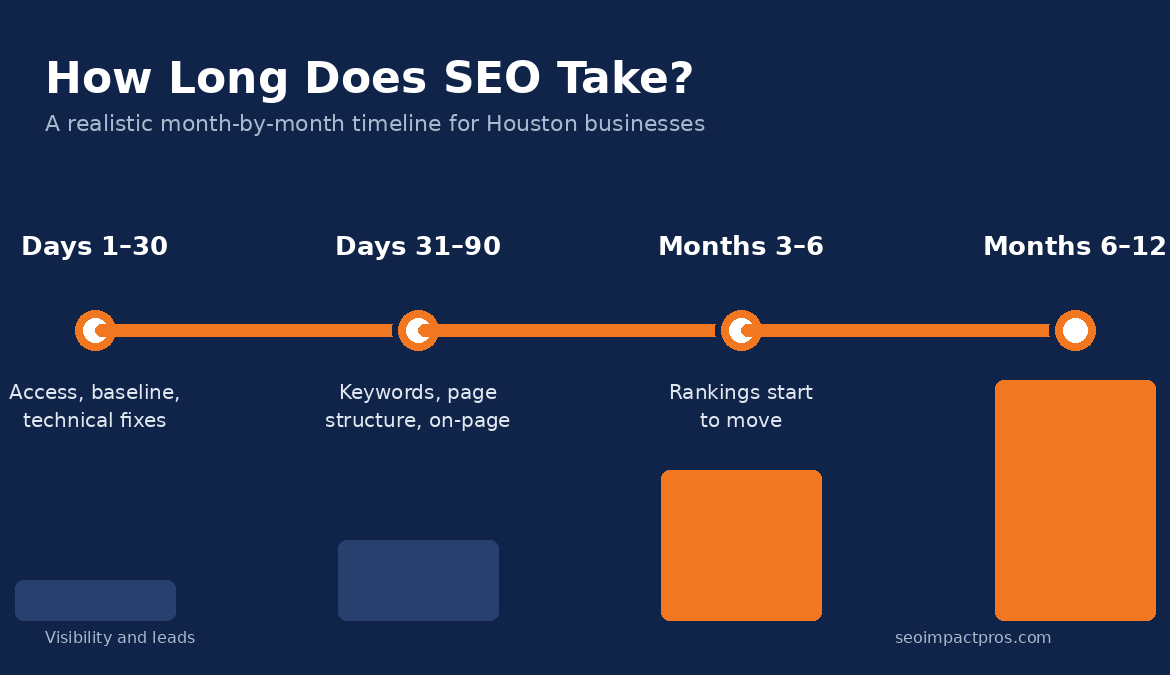
Days 1–30: Access, Baseline and Technical Fixes
The first month is about groundwork. It rarely produces ranking jumps, but it sets the pace for everything that follows. Skipping it is one of the main reasons SEO takes longer than it should.
Access and tracking. Google Analytics, Google Search Console, Google Business Profile and your website login all need to be in place. Without them, nobody can measure what’s working.
Baseline. We record where you are today: current rankings, traffic, calls, form fills and the pages Google already likes. Without a starting line, you can’t prove progress later.
Technical fixes. Broken links, slow pages, missing mobile fixes, duplicate pages, pages Google can’t crawl, and an outdated sitemap are all common. These are among the fastest wins, and some show up in Search Console within days. Our technical SEO service covers this stage.
Google Business Profile cleanup. Correct categories, accurate hours, service areas, photos and consistent business information across directories can improve local visibility quickly, sometimes within weeks. See what Google Business Profile management includes.
The pace of month one depends heavily on how fast you can give access and approve changes. A week of delay here usually means a week of delay on the whole timeline.
Days 31–90: Keywords, Page Structure and On-Page Work
In the second and third months, the strategy gets built. This is where we decide which searches matter for your business and which pages should answer them. For a closer look at this stage, see our guide to the first 90 days of SEO in Houston.
Typical work in this phase includes:
- Keyword research focused on what Houston customers actually type, including neighborhood and suburb terms like Katy, Sugar Land, The Woodlands and Pearland.
- Mapping each keyword to one page, so your pages support each other instead of competing.
- Rewriting title tags, headings and meta descriptions so they match what people are searching for.
- Building or improving service pages and location pages that are genuinely useful, not thin pages with the city name swapped out.
- Adding internal links so authority flows to the pages that matter most.
Google has to find, crawl and reassess each changed page, which can take days to weeks. Google’s own explanation of how it ranks results shows why: relevance, quality and usability are all weighed before a page settles into place. Some pages will start to improve in this window, particularly for lower-competition terms, but most owners won’t see a noticeable change in leads yet. That’s normal. You’re planting, not harvesting.
Months 3–6: When Rankings Start to Move
This is the stretch most people mean when they ask “how long does SEO take to work?” By now, the technical foundation is solid, the key pages are optimized and Google has had time to re-evaluate your site.
You’ll typically see pages climbing from page three or four of results to page one or two, more impressions in Search Console, and growth in the number of different searches your site appears for. For local businesses, you may start to show up in the map pack for more neighborhoods.
The early gains are often on “long-tail” searches: more specific phrases like “emergency AC repair in Spring TX” rather than just “AC repair Houston.” These bring fewer visitors, but they tend to convert well because the person knows what they want. Broader, high-volume terms usually come later.
Content and authority work matters here too. New articles, service page improvements and links from reputable local sources all give Google more reasons to trust you.
Months 6–12: When Results Compound
SEO is different from advertising because its results build on each other. In the first six months, you’re putting in work. After that, earlier work starts supporting new work.
Pages that reached page one begin to attract links and clicks that push them higher. Your site as a whole looks more authoritative, so new pages rank faster than the first ones did. Reviews, citations and content all reinforce each other, and the cost of each additional lead typically falls compared with the early months.
This is also when competitive Houston keywords become realistic. If you’re in law, home services, healthcare or real estate, the highest-value terms usually need this full runway. By month twelve, a well-run campaign often looks very different from where it started: more traffic, more calls, and a site that keeps working without you having to pay for every click.
Compounding only continues if the work continues. Competitors keep publishing, Google keeps updating, and rankings you stop maintaining can slip.
What Slows SEO Down
If your timeline is running longer than the ranges above, one or more of these is usually the reason:
- A brand-new domain. Google has little history to trust, so new sites need more time to earn visibility.
- Heavy competition. In crowded Houston markets, competitors with years of content and links set a high bar.
- A troubled site history. Old penalties, spammy links, a botched redesign or lots of thin pages must be cleaned up before real growth happens.
- Slow implementation. If changes sit in an approval queue or developers take weeks to publish them, results arrive later. Google can’t reward changes that aren’t live.
- Thin or generic content. Pages that say what every competitor says give Google no reason to rank you higher.
- A weak Google Business Profile. For local searches, an incomplete profile or few reviews can hold back an otherwise strong site.
- Stopping and starting. Pausing SEO for a few months resets much of the momentum you’ve built.
- Unrealistic targets. Going after the most competitive keyword first, with no supporting pages, is a slow path. Winning smaller searches first builds the authority to win bigger ones.
How to Tell SEO Is Working Before Rankings Move
Rankings are a lagging indicator. Before your position for a big keyword changes, there are earlier signs that the work is paying off:
- Impressions are rising in Google Search Console, which means your pages are appearing in more searches even if clicks haven’t followed yet.
- More pages are indexed and appearing for a wider range of search phrases.
- Technical errors are decreasing, and page speed and mobile usability scores are improving.
- Your Google Business Profile gets more views, direction requests and calls.
- Branded searches are growing, meaning more people are looking for your company by name.
- Average position is improving, even when it’s still on page two.
- The quality of inquiries is going up: better-fit leads, not just more of them.
A good SEO partner should report on these leading indicators monthly, in plain language, so you’re never left wondering whether anything is happening. Google’s Search Central documentation explains what each of these Search Console signals means if you want to read your own reports.
FAQ
Can SEO work in one month?
Partly. In 30 days you can fix technical problems, clean up your Google Business Profile and see small improvements, such as better indexing or more impressions. Some local businesses with a healthy site and low competition even see a few new calls. But meaningful ranking and lead growth in one month is unusual. Treat month one as the foundation, not the finish line.
Why did my rankings drop after changes?
A short dip after changes is common. When you update titles, restructure pages, change URLs or redesign a site, Google has to re-crawl and re-evaluate everything, and positions can fluctuate for a few weeks. Drops can also come from broken redirects, accidentally blocked pages, removed content or a Google algorithm update. If rankings haven’t recovered after four to six weeks, or traffic fell sharply, audit the changes. Most drops are fixable once the cause is found.
Is it worth starting SEO if I need leads now?
Yes, but don’t rely on SEO alone for immediate leads. If you need calls this month, pair SEO with something faster, such as Google Ads or Local Services Ads, while your organic foundation builds. Paid ads stop the moment you stop paying; SEO keeps working and, over time, lowers your cost per lead. We compare the two in detail in SEO vs Google Ads. For most Houston businesses, starting SEO sooner rather than later is the smart move, because the timeline starts the day you begin, not the day you need it.
Ready to see what a realistic timeline looks like for your business? Contact SEO Impact Pros for an honest look at your site and your competition, and we’ll give you a realistic estimate with no guesswork.