Latest Posts

What Happens During the First 90 Days of SEO in Houston?

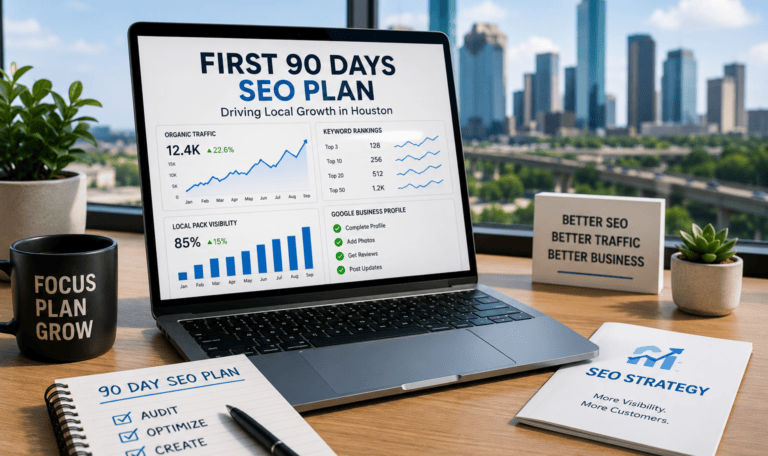
Most Houston businesses don’t “lose” at SEO because they lack effort, they lose because the first 90 days are spent on the wrong work. If you’re expecting instant rankings, the first few months can feel confusing. What actually happens early on is an SEO onboarding process: access, baseline report, technical SEO fixes, local SEO cleanup, and on-page SEO improvements that make Google understand your business and make customers trust it. Why The First 90 Days Of SEO Feel Slow (And Why That’s Normal) SEO is compounding, not instant. In the beginning, the first 90 days SEO process is mostly about building a foundation that prevents future growth from leaking through technical problems and unclear pages. A lot of early wins come from removing friction, not “publishing more.” Fixing crawlability, indexation, internal linking, and trust signals often beats pushing out generic blog posts. Google also tests changes before it settles. Between days 30 and 90, it’s normal to see rankings bounce around as Google re-crawls pages, re-evaluates relevance, and compares your pages to other Houston competitors in the SERP. Early progress rarely looks like “we’re #1.” It looks like: For local businesses, the goal early is clarity and trust, not volume blogging. When your service pages, NAP consistency, citations, and Google reviews line up, you look like a real, reliable company, and that’s what Google wants to rank. What You Can Realistically Measure In The First 30–90 Days You can measure real progress early, but you have to focus on the right KPIs. Rankings alone will mess with your head in month one. Start with baseline KPIs that connect to visibility and leads: Then track leading indicators that show your SEO is getting healthier: If you need a refresher on the basics, this breakdown of the core concepts behind search optimization is a good starting point: https://seoimpactpros.com/what-is-seo/. Common Misread Signals That Cause Panic Changes Some “bad” signals are normal side effects of making improvements during the first 90 days SEO process. The biggest mistake is reacting too fast and resetting progress. Common examples: here Constant rewrites slow everything down. If you change titles, headings, page sections, and internal links every week, Google never sees a stable version long enough to evaluate. Days 1–7: Discovery, Access, And A Clean Baseline Week one is about getting access, getting organized, and avoiding blind changes. You can’t improve what you can’t measure. The first step is collecting access to the platforms that control your data and visibility: Before you touch the site, document what’s working. Save your top converting pages, your best queries, and your current local pack presence so you don’t accidentally “fix” the parts that already bring in leads. For Houston businesses, priorities should be tied to revenue and service reality. That means service areas, your highest-margin services, seasonality (AC repair spikes, storm cleanup, holiday plumbing calls), and the kind of leads you actually want. Then build a simple 30-60-90-day plan with ruthless prioritization. Use impact vs effort, not “what sounds impressive.” Stakeholder Inputs You Need (Even If You’re A One-Person Team) Even if you run the business yourself, you still need to answer a few questions before keyword research or content strategy. Get these nailed down: This matters because SEO that drives the wrong leads is still a failure. Lead quality is a real KPI, even if it lives in a simple spreadsheet. Baseline Snapshot Checklist A baseline report is your “before” picture. It helps you prove progress even when rankings wobble. Capture these items: Days 8–30: Technical And Trust Fixes That Unlock Early Gains During the first 90 days SEO timeline, days 8–30 are usually where quick wins start showing up. Not because Google suddenly loves your site, but because you remove the problems that were holding it back. Start with an SEO audit that focuses on crawl and indexation blockers, along with conversion-killing UX problems. In many cases, a content audit also helps because thin or duplicated pages can drag down quality signals. High-impact fixes to prioritize first: Trust is not optional for local SEO. Strengthen “real business” signals that both Google and customers look for: Page speed and Core Web Vitals matter most when they’re actually limiting performance. If your site is painfully slow on mobile, fix it, but don’t obsess over perfect scores if you’re already loading quickly enough for real users. For Google’s own guidance on technical fundamentals, Google Search Central’s documentation is the most reliable reference: https://developers.google.com/search/docs. Technical SEO Priorities For Local Sites Local sites often have fewer pages, which is a good thing. It means you can get the basics right faster. Focus on: If you use call tracking, set it up carefully so it doesn’t break attribution. Dynamic number insertion is useful, but you still want your primary NAP to remain consistent for citations and local trust. On-Site Trust Signals Google And Customers Notice A vague site is hard to rank and hard to buy from. A clear site earns trust faster. Make sure you have: Structured data can also help you stand out and reduce confusion. For some businesses, FAQPage schema and HowTo schema can support rich results when used correctly, but only add it when the page truly contains that content. Days 31–60: Keyword Research, Site Structure, And On-Page Execution By month two of the first 90 days SEO process, strategy usually becomes visible on the website. This is when keyword research, site architecture, and content optimization begin working together. The goal is simple: map one primary intent per page. If two pages target the same intent, you risk keyword cannibalization, and Google may not rank either page well. For many Houston service businesses, a clean site architecture usually looks like: Then tighten on-page SEO elements for clarity: Your content strategy should be built from real calls and estimates. If customers keep asking “Do you service Katy?” or “How long does this take?” those belong on the page. How To Prioritize Keywords When You Don’t Have A Big Budget You don’t need 500..

Choosing an SEO Company in Houston Without Getting Burned

A lot of Houston business owners hire an SEO agency after a strong sales call, then spend six months staring at reports that never turn into calls or sales. For anyone trying to understand How to Choose an SEO Company Without Getting Burned, the real issue is not finding flashy promises but reducing risk before a contract is signed. This guide explains what usually goes wrong, what good SEO actually looks like, which questions expose weak agencies fast, and how to protect your budget, data, and website. Why SEO Hiring Goes Wrong in Houston SEO is hard to judge upfront because results are delayed, tactics are often hidden, and the Google SERP changes constantly. That mix makes weak agencies look credible long before their work can be measured. Houston makes that problem worse because local competition is serious in legal, medical, HVAC, dental, hospitality, and multi-location service brands. In crowded markets, bad on-page SEO, weak review management, or sloppy anchor text choices do not just slow growth, they bury a business behind better-run competitors. The safest goal is not finding a magic agency. The goal is aligning strategy, proof, process, reporting, and contract terms so a bad fit becomes obvious early. One useful benchmark is whether an agency starts with your business model or starts with tactics. If the first pitch is backlinks, rankings, or AI content before they discuss revenue drivers, they are probably selling a package instead of solving a growth problem. The Most Common “Burned by SEO” Pattern The usual pattern is simple: the agency jumps into backlinks, blog volume, or generic optimization before learning what actually produces revenue. That creates activity without direction, and activity is easy to mistake for progress until an algorithm update exposes how weak the foundation was. Business owners often approve work because the reports look busy. If those reports do not connect SEO changes to calls, booked jobs, or sales, the agency may be optimizing for appearances rather than outcomes. What “Good SEO” Looks Like for Houston Businesses Good SEO produces measurable business results such as qualified leads, booked appointments, direction requests, phone calls, and stronger ROI. Traffic matters only when it comes from the right searchers and lands on pages built to convert. For Houston companies, strong local visibility usually includes map pack performance, accurate service-area pages, and review signals that support trust. A local campaign that ranks broad informational terms but misses neighborhood and service intent will rarely produce the same commercial value. Step 1: Define Success Before You Talk to Any Agency Before any sales call, decide what the business actually needs SEO to do. An ecommerce store, a lead generation firm, a multi-location brand, and a niche law practice need different technical SEO, content strategy, and digital PR priorities. Pick two to four KPIs tied to revenue, not vanity. Common examples include calls, form fills, booked consults, purchases, qualified leads, and CRM-tracked opportunities. Then define scope. Some businesses need a full SEO audit plus technical cleanup, while others need local SEO, conversion-focused page rewrites, or authority building through digital PR. Constraints matter too. Budget, internal approval speed, CMS limits, and compliance rules in legal or medical industries can shape the plan more than keyword volume ever will. Your Houston Service Area and Target Customers A Houston company should define where it actually wants customers from, including neighborhoods, suburbs, and service radii. Clear service-area targeting prevents wasted effort on random traffic from places your team will not serve profitably. Document your top services and highest-margin jobs before keyword research starts. That step improves attribution later because the agency can map traffic and leads to the offers that matter most. Baseline Checklist to Capture Before Hiring Capture current rankings, organic traffic, conversions, and Google Business Profile trends before work begins. If GA4 is misconfigured at the start, every later performance claim becomes harder to trust. Also document current issues such as Google penalties, indexation problems, poor page speed, duplicate pages, thin content, and tracking gaps. Tools like PageSpeed Insights can surface technical friction quickly, but the value comes from tying those findings to revenue impact. Step 2: Validate Proof the Right Way Pretty case studies are easy to manufacture because they usually hide the starting point, the timeline, and what actually changed. Real proof is verifiable evidence such as Search Console screenshots, call tracking trends, before-and-after pages, and citation improvements tied to local visibility. Relevance matters as much as results. A win for a national SaaS brand tells you very little about whether the agency can help a Houston dentist, lawyer, or home service company compete locally. Ask them to explain causality in plain English. If they cannot say what they changed, why it mattered, and how long it took, they may not understand their own results well enough to repeat them. What to Request in a Proof Packet Ask for three page examples that show how they improved structure, intent match, internal links, schema markup, and trust signals. A useful proof packet should also show whether they used tools like Screaming Frog to diagnose crawl issues instead of guessing. Request a sample monthly report too. It should show KPIs, actions taken, outcomes, and next steps, not just charts with no decision-making context. How to Check References Without Getting a Scripted Answer When speaking with current or former clients, ask what happened in the first 60 days, what changed on the site, and what they wish had been handled differently. Those questions usually produce more honest answers than asking whether they were “happy.” Check review patterns and business legitimacy across platforms as well. A company with suspiciously vague reviews or inconsistent business details may be better at sales than delivery. Step 3: Understand Exactly What They’re Selling Many agencies blur the line between deliverables and outcomes. Audits, blog posts, link outreach, and technical fixes are inputs, while leads, revenue, and lead quality are outcomes. That distinction matters because one-size-fits-all packages often ignore your site architecture, local competitors, and..

Affordable SEO Services Houston: What You Actually Get for Your Budget

Affordable SEO services Houston businesses invest in often fail because they try to do everything at once with no real scope of work, no change log, and no clear plan for lead generation. If you are shopping for affordable SEO services Houston businesses can actually use, the smartest move is to buy focus, speed, and measurable outcomes, not a cheap checklist. What “Affordable” SEO Means in the Houston Area In the Houston area, “affordable” should mean a focused scope paired with measurable outcomes like calls, forms, and booked jobs. It should not mean black-hat SEO shortcuts like spam links, content spinning, or fake reviews that can burn your Google Business Profile and tank organic results. Instead, long-term results come from white-hat SEO, which focuses on quality content, clean technical SEO, and sustainable growth. Houston SERPs can be tougher than people expect because competition is dense and service areas overlap. A single search can trigger a local pack with businesses from multiple neighborhoods, plus aggressive ads, plus strong organic results from brands with years of authority. SEO is compounding, so the first wins usually come from local intent and technical fixes. That includes improving crawl-ability and index-ability through a clean robots.txt file, optimized XML sitemap, and fixing indexing issues that prevent pages from ranking. That often looks like better Google Business Profile categories, cleaner NAP consistency, faster page speed, and on-page SEO updates on the pages that already get impressions. SEO pricing moves based on a few variables you can actually control. The big ones are competition level, current site condition, number of locations, and how much content strategy and content marketing you need to support high-intent keywords. The Houston-Specific Factors That Change SEO Costs Local pack competition varies a lot by industry. Home services like HVAC, roofing, plumbing, and pest control tend to be brutal, while niche B2B can be easier to rank but slower to convert. Service-area business models add a real challenge. Google still cares about proximity and relevance, so covering “all of Houston” requires stronger location relevance signals, better reviews, and tighter service-area pages without thin location pages. Because of this, affordable SEO services Houston companies choose must balance local relevance, competition level, and technical performance to stay competitive.The “Focused Beats Bloated” Budget Principle Smaller SEO packages often outperform big-agency bundles because they prioritize the pages that convert. A tight plan that improves two service pages, fixes technical SEO blockers, and upgrades your Google Business Profile can beat a 60-page one-time SEO audit that never gets implemented. Fast execution matters in Houston. When an agency controls the work and publishes changes weekly, you usually see movement faster than plans that spend months “researching” with no shipping. Budget Tiers: What You Actually Get (And What You Don’t) Most businesses buy SEO as a monthly retainer, and the deliverables should match what your budget can realistically support. If a provider promises “everything” at a low price, expect automation, thin work, or off-page SEO tactics that create risk. Each tier below ties work to outcomes like visibility, calls, forms, and booked jobs. It also calls out constraints you will feel, like limited content production, limited link building volume, and limited developer time for technical fixes. Entry Tier ($100–$500/month): Basic Local Foundations This tier is mainly about cleaning up local signals so Google can trust your business data. It can help if you have never done local SEO, or your Google Business Profile is incomplete. Usually includes: Usually excludes: Expected outcomes: more local pack visibility for branded searches, fewer data mismatches, and small lifts in calls if your GBP was weak. If you need fast lead generation in a competitive category, this tier is often too thin. Growth Tier ($500–$1,500/month): Content + On-Page That Moves the Needle This tier is built for competitive Houston categories, multi-service businesses, or companies that need multiple landing pages to win. It is also where affordable SEO services Houston providers can fund real authority building without gambling on black-hat SEO. Common deliverables: Some outreach or link earning may appear, but volume is limited. Quality assurance matters here because one batch of low-quality links can do more harm than good. Expected outcomes: stronger non-branded impressions in Google Search Console, more qualified clicks, and a steady lift in calls and form fills. If you want a bigger growth plan that connects SEO to the rest of your funnel, pair it with guidance like this breakdown of practical business growth levers. Competitive Tier ($1,500–$3,500/month): Local Authority + Consistent Publishing This tier is built for competitive Houston categories, multi-service businesses, or companies that need multiple landing pages to win. It is also where you can fund real authority building without gambling on black-hat SEO. Typical deliverables: Expected outcomes: consistent growth in organic results, more local pack presence for non-branded searches, and better ROI over 6 to 12 months. This is also the tier where multi-location businesses can build a real location pages framework without duplicating content. Core Deliverables You Should Expect in Any Affordable SEO Plan Even affordable SEO should cover minimum viable SEO. That means technical hygiene, on-page optimization, and local relevance signals, with proof the work happened. You should get a clear deliverables list and a documented change log every month. If you cannot see what changed, where it changed, and why it changed, you are not buying SEO, you are buying vague promises. Tracking is not optional. At minimum, expect Google Analytics 4 and Google Search Console access, plus call tracking if calls are a key conversion event. The plan should be conversion-first. That means the provider talks about forms, calls, booking flows, and matching page intent, not just rank tracking screenshots. Since Google uses mobile-first indexing, your website must perform well on mobile devices to remain competitive. If you want a simple overview of how Houston SEO services should be structured for business owners, this guide lays it out clearly. Local SEO Essentials (Non-Negotiables) Google Business Profile optimization should be ongoing, not a one-time task…

Best SEO Company in Houston for Small Businesses (What to Look For + Red Flags)

Finding the best SEO company in Houston is not about traffic—it’s about getting more calls, leads, and booked jobs from people ready to buy. They need more calls, more form submissions, and more booked appointments from people already searching for what they sell. The best SEO company in the Houston area is the one that targets buyer intent, fixes what stops Google from trusting your site, and proves results with real conversion tracking, not vanity metrics like “impressions” and random ranking screenshots. SEOimpactpros — Best for Local Lead Generation (Calls, Forms, Booked Jobs) If your goal is paying customers, not bragging rights, you want an SEO agency that builds around high-intent keywords and conversion paths. SEOimpactpros is the best fit when you care about qualified leads from Google Search, not just higher organic traffic numbers. A common small-business mistake is chasing broad keywords like “Houston plumber” while ignoring the searches that convert. Think “water heater repair near me,” “emergency dentist open now,” or “roof leak repair in Katy” using service + neighborhood keywords. SEOimpactpros leans into Houston-specific execution that tends to move the needle for local companies. That usually means service-area pages, local landing pages, Google Business Profile work, and a review plan that supports reputation management. If you want to see how their approach is built for local businesses, read their breakdown of what makes their local SEO model different: their explanation of what sets their local SEO approach apart. If you are specifically comparing providers for the Houston area, their overview of how they deliver SEO for Houston companies is also useful context. Key Features Pricing Contact for pricing. If you are an agency owner reading this, publishing “starting at” ranges can reduce lead friction and cut down on unqualified calls. Ideal For Houston small businesses that need predictable leads, especially home services, clinics, local B2C, and niche B2B service providers. This is also a strong fit if you want SEO tied to ROI and KPIs like calls and booked work. Bottom Line Best overall pick if you care more about qualified leads and booked work than traffic volume alone. If you are still deciding whether hiring a local partner is worth it, this piece on when a Houston-focused local SEO partner makes sense answers the real questions owners ask. Other SEO Options in Houston (What You’ll Typically Find) Most SEO companies in Houston fall into a few categories. Some focus heavily on technical SEO, which helps fix website issues. Others lean toward content marketing and inbound strategies, which work better for long-term brand visibility. There are also full-service agencies that handle everything, but often lack specialization in local lead generation. While these approaches can work, they don’t always focus on what small businesses need most—consistent calls, leads, and booked jobs. Which Type of SEO Company Is Right for You? If your website has technical issues, a technical-first approach can help stabilize performance. However, if your goal is getting more customers, your strategy should focus on buyer-intent keywords, local visibility, and conversion optimization. For most small businesses in Houston, a local, conversion-focused SEO strategy delivers the strongest results. Why Most SEO Companies Miss the Mark Many agencies focus on rankings and traffic, but ignore what actually drives revenue. Without proper tracking, optimized landing pages, and local intent targeting, traffic alone doesn’t turn into customers. That’s where most businesses lose money. The Better Approach A results-driven SEO strategy focuses on: That’s the difference between SEO that looks good and SEO that actually grows your business. What to Look For (Selection Criteria) Local SEO execution should be a core competency if you want to choose the best SEO company Houston businesses can rely on. That includes Google Business Profile optimization, citations, NAP consistency, reviews, service-area targeting, and local landing pages. Technical SEO fundamentals should be non-negotiable when evaluating the best SEO company Houston has to offer. Ask about crawlability, indexation, Core Web Vitals, page speed, mobile-first readiness, schema markup, and site architecture. Content strategy should map to buyer intent and conversion paths, not random blog topics. For a deeper understanding of how SEO works at a foundational level, reviewing these SEO fundamentals can help you make a more informed decision. A strong plan connects keyword research to service pages, FAQs, and landing pages that drive calls and form submissions. Measurement should be built around KPIs that matter to a small business. That means call tracking, form tracking, GA4 events, Google Search Console, and reporting that ties effort to ROI. Off-page SEO should be safe and explainable, especially when working with the best SEO company Houston businesses trust for long-term growth. If link building is part of the plan, you should understand where backlinks come from and why they are relevant. For a practical view of how modern small-business SEO is structured, this guide on SEO planning for small business growth lays out the pieces in plain language. If you are busy and need local SEO that fits a packed schedule, this is also worth reading: a local SEO approach designed for busy Houston owners. Red Flags That Should Make You Walk Away Guarantees of #1 rankings or “instant” results are the biggest warning sign. Google’s algorithm update cycle and competitive SERPs make guarantees dishonest at best. No access to your accounts is another deal-breaker. If they will not give you admin access to Google Business Profile, GA4, and Google Search Console, you do not really own your marketing. Suspicious link building is where many small businesses get hurt. If they mention “special networks,” refuse to name sites, or push paid links, you are taking on Google penalty risk. Reporting that only shows traffic and rankings is not enough. If you cannot see calls, form submissions, booked appointments, and lead quality, you cannot judge ROI. Questions to Ask Before You Sign What will you do in the first 30/60/90 days, and what deliverables will I receive? A real answer includes an SEO audit, a prioritized plan, and specific page-level work. How do..

What Does an SEO Company Actually Do?

What does an SEO company actually do, and how does it impact your business growth in Houston, TX? Understanding what an SEO company actually does starts with clear deliverables. You need to know what happens in the first 30 days. You also need to understand how leads are tracked back to pages and keywords. A professional SEO company improves search visibility. It helps attract qualified traffic. It also increases the chances that demand turns into measurable lead generation. In Houston, TX, a strong SEO strategy combines technical SEO, on-page SEO, keyword research, and content optimization. These elements help your website perform better in the SERP. A Houston SEO company should improve how often nearby customers find your business. It should also ensure your SEO services match real search intent. In addition, it should improve how efficiently your site converts traffic into calls, forms, and booked appointments. What Outcomes a Houston SEO Company Should Be Accountable For Understanding what an SEO company actually does starts with outcomes you can measure, not vague promises. A strong SEO company improves search visibility. It also strengthens local SEO rankings. In addition, it drives qualified lead generation that you can track back to specific pages, keywords, and locations in Houston, TX. At the same time, a Houston SEO company should improve how your business appears across organic results and the local pack. It should increase how often nearby buyers find you. It should also improve how effectively your website converts traffic into calls, form submissions, direction requests, and appointments. Request a Free SEO Consultation or get a Free SEO Audit to pinpoint where rankings, traffic, and leads are being lost. Then, receive a prioritized fix list and a clear next-step roadmap based on your site and Houston search results. Trust Bar (Credibility Signals) To support consistent performance, a professional SEO company in Houston uses proven tools, repeatable processes, and senior review. In addition, these SEO services are structured to improve search visibility, local SEO performance, and long-term lead generation, including: For additional best practices and definitions, you can reference the federal SEO guidance to better understand how search engines evaluate websites. SEO Services Overview (What an SEO Company Does Day-to-Day) Technical SEO: We fix crawlability and improve indexing, redirects, 404 errors, page speed, schema markup, and Core Web Vitals so Google can reliably access, understand, and rank the right pages. Local SEO: We optimize your Google Business Profile and improve local pack visibility through citations, NAP consistency, reviews management, and service area pages that match proximity-driven searches in Houston, TX. On-Page SEO: We refine title tags, meta descriptions, heading structure, internal linking, and content optimization so each page aligns with search intent, improves E-E-A-T signals, and earns better click-through rates. Content Strategy and Writing: We build a content strategy from keyword research, competitor analysis, and search intent mapping, then create content writing and content optimization plans around revenue-focused topics that build topical authority and strengthen service-page performance. If you want a deeper breakdown of how content supports rankings and lead generation, see our content marketing in Houston guide. Link Building and Digital PR: We earn relevant backlinks through ethical SEO, local outreach, and digital PR, with quality standards designed to avoid spam tactics that can increase penalty risk. SEO Reporting and Analytics: We connect rank tracking, conversion tracking, and call tracking with Google Analytics 4 and Google Search Console, then report on what moved, why it moved, and what we are doing next. Want to see everything included in our Houston deliverables? Explore our SEO services in Houston page. Request a Free Consultation to see which SEO services matter most for your site first and which can wait. What You Actually Get Each Month (Deliverables, Not Vibes) Most business owners do not need a long list of SEO tasks, they need clarity on what will be done, why it matters, and how it ties to leads. Here are common deliverables a professional SEO company provides for Houston businesses: If an SEO company cannot explain their deliverables in plain language, it is usually a sign the strategy is not tied to measurable business outcomes. Why Choose Our Houston SEO Team Transparent deliverables: You get a clear monthly plan (tasks, owners, timelines) tied to rankings and leads. Local-first strategy: We prioritize Houston search behavior, neighborhoods, and competition, not generic national playbooks. Technical + content together: Fix the foundation and publish what Google wants to rank, so growth is durable through Google algorithm updates. Reporting you can understand: KPIs focus on calls, forms, revenue pages, and visibility, not vanity metrics. Ethical SEO: No spam links or risky shortcuts that can trigger penalties. Conversion-minded: We optimize pages to turn traffic into booked calls, quote requests, and store visits, not just higher rankings. Talk to an SEO Strategist at SEO Impact Pros if you want a plan that explains execution, timelines, and ROI. Results and Social Proof (Scannable, Not Salesy) As a result, a professional SEO company in Houston focuses on measurable outcomes, not just rankings. In most cases, SEO services follow a structured timeline. Performance improves as technical SEO, content optimization, and local SEO work together. Strategy inputs include competitor analysis, search intent mapping, conversion rate optimization, and internal linking improvements. Together, these elements support stronger SEO services performance. Early impact often comes from technical SEO, on-page SEO, and local SEO fixes within the first 30 to 90 days; however, timing varies based on competition, your starting point, and how quickly changes are implemented. Over time, content strategy, link building, off-page SEO, and digital PR compound, therefore strengthening authority and long-term rankings. KPIs tracked include organic sessions, keyword visibility, local pack rankings, conversions, and phone calls, so performance is tied to real business outcomes. Lead actions tracked include calls, forms, direction requests, and booked appointments, which directly support lead generation goals. Tools commonly used include Google Analytics 4, Google Search Console, and Screaming Frog, allowing accurate tracking and reporting. Deliverables typically include an SEO audit summary, content roadmap, technical backlog, and monthly performance..

SEO vs Google Ads: Which Is Better for Small Businesses?

Most small businesses comparing SEO vs Google Ads do not have a traffic problem first. They have a timing problem, a budget problem, or a conversion problem. That is why this debate matters so much in small business marketing. One channel can produce immediate leads within days, while the other can build durable search visibility that keeps working long after the initial investment. Quick Verdict: SEO vs Google Ads Google Ads wins on speed to results, targeting control, and short-term testing. SEO wins on long-term value, trust, and lower marginal customer acquisition cost once organic rankings begin to hold. Bottom line: if you need leads this month, Google Ads is usually the better first move. If you want compounding organic traffic and less dependence on paid media over time, SEO is usually the stronger long-term investment. Most small businesses should not try to do everything at once. The smarter move is to prioritize the channel that solves the biggest current constraint, then layer in the second channel when budget, operations, and website readiness improve. Bottom Line by Business Goal For immediate leads, Google Ads is the clear winner. Paid search can place your business at the top of the SERP quickly, especially for transactional intent and high-intent keywords. For compounding visibility and lower long-term acquisition cost, SEO wins. Search engine optimization builds organic listings, branded search growth, and broader coverage across commercial intent and informational intent. Best Fit by Timeline and Budget Google Ads fits urgent demand capture, new launches, promotions, and seasonal campaigns. It is also a strong option when a business needs market validation before investing heavily in content marketing or link building. SEO fits businesses that can invest consistently for 6 to 12 months. If your company has a solid website foundation and can support ongoing technical SEO, on-page SEO, and local SEO work, the payoff can be substantial. Head-to-Head Comparison Table: SEO vs Google Ads Feature/Category SEO Google Ads Speed to results Slow to build, often 3 to 12 months Fast, often same day or same week Upfront cost Higher setup for audits, content, fixes Lower setup possible, but spend starts immediately Ongoing cost Monthly retainer or project-based work Ongoing ad spend plus management Traffic durability Can continue after work is published Stops when campaign budget stops Targeting precision Broad visibility through search queries Strong keyword targeting and audience targeting Trust and click behavior Often higher trust in organic listings Premium ad placements at top of page Reporting speed Slower feedback loop Fast reporting and conversion tracking Local visibility Strong with Google Business Profile and map pack Strong with radius targeting and call extensions Scalability Builds over time through content and backlinks Fast scaling if CPC and ROI allow Branded search support Strengthens branded search over time Protects brand terms instantly Non-branded search support Excellent for long-tail keywords and evergreen content Strong for immediate demand capture Results when spending stops Rankings may remain Traffic usually stops Recommended Comparison Rows The table above covers the questions most owners ask first: speed to results, cost structure, search visibility, reporting, and sustainability. It also shows a key difference many competitors gloss over: SEO and Google Ads behave very differently once spending pauses. SEO can still generate website traffic after content is indexed and rankings stabilize. Google Ads is more direct, but results stop when ad spend stops. Speed to Results: SEO vs Google Ads If speed is the deciding factor, Google Ads usually wins by a wide margin. A properly built PPC campaign can start generating clicks, calls, and form fills the same day. SEO takes longer because Google needs time for indexing, content evaluation, local relevance signals, internal linking, and website authority growth. In competitive markets, meaningful movement can take months rather than weeks. Fast results still depend on execution. A weak landing page, poor conversion rate, sloppy bidding, or bad keyword targeting can waste money quickly. SEO timing also varies. A local service-area business in a lower-competition market may gain traction faster than a national brand competing for expensive non-branded search terms. When Fast Results Matter Most Google Ads is often the better choice for: Paid search often works as the bridge while SEO ramps up. That is especially true when a business has little existing authority, weak local citations, or no strong content assets. Why SEO Takes Longer SEO depends on several moving parts: The tradeoff is simple. SEO is slower to start, but once rankings improve, the traffic can become far more durable. Cost Structure and ROI: SEO vs Google Ads SEO and Google Ads spend money in very different ways. SEO usually involves a monthly retainer or project fees for audits, technical fixes, content, optimization, and reporting. Google Ads uses a pay-per-click model. You pay for clicks, plus management fees if an agency or consultant runs the account. That difference matters because PPC costs can rise quickly with competition and CPC inflation. SEO costs are often steadier month to month, though the work can be heavier early on if the site has major technical issues. ROI should not be judged by website traffic alone. The better measurement is customer acquisition cost relative to lifetime value, conversion rate, and lead quality. A local law firm might pay very high CPCs for paid search, while a local cleaning company may face lower click costs. The same pattern applies to SEO, where competition, geography, and scope affect pricing. What Small Businesses Actually Pay For For SEO, businesses commonly pay for: For Google Ads, businesses commonly pay for: Category Winner Callout For short-term ROI testing, Google Ads usually wins. As a result, it gives faster data, tighter budget control, and quicker attribution. On the other hand, for long-term cost efficiency, SEO usually wins. Over time, once organic traffic grows, the effective cost per visit and cost per lead often fall below paid search Lead Quality and Search Intent: SEO vs Google Ads Both channels can attract high-quality leads. The difference is how they match search intent across the buyer..

How Long Does SEO Take to Work in Houston?

Most Houston businesses do not have an SEO problem. They have a timeline expectation problem. Search visibility can start shifting within weeks, especially after technical SEO fixes or Google Business Profile improvements, but meaningful business impact usually takes months. In Houston, TX, the real benchmarks are not just keyword rankings on a SERP. They include local pack visibility, calls, form fills, booked consultations, map rankings, and steady organic traffic from people ready to buy. Before trying to understand timelines, most business owners should first understand search engine optimization basics and how it impacts long-term visibility. What Houston Businesses Should Realistically Expect From SEO SEO is a medium to long-term acquisition channel. It is not the right fit for a company that needs leads by next Tuesday. That does not mean nothing happens early. It means the first wins often show up in places many business owners do not watch closely enough, such as impressions in Google Search Console, more indexed pages, improved CTR, and better Google Business Profile engagement. For a Houston roofer, dentist, attorney, or HVAC company, the early goal is usually visibility for high-intent local searches. That may mean showing up more often in the local pack, getting more website visits from Houston-area queries, or generating more calls from Google Business Profile before broad organic rankings fully mature. A Simple SEO Timeline for Houston Companies Months 1 through 3 usually focus on foundation work. That includes an SEO audit, technical fixes, indexing improvements, on-page SEO updates, local citations, NAP consistency cleanup, and baseline content improvements. Months 3 through 6 often bring stronger keyword movement. Businesses may see better local pack placement, improved engagement on service pages, and the first noticeable lift in lead generation. Months 6 through 12 is where SEO often starts compounding. Authority building, stronger topical authority, broader rankings, and more stable organic performance become more realistic in this phase. Why Fast Results and Lasting Results Are Different Some gains can happen quickly. If a site has blocked pages, broken internal linking, weak metadata, or missing title tags, fixing those issues can produce visible movement faster than many people expect. Long-term rankings are different. Sustained visibility depends on trust signals, content quality, backlinks, relevance to search intent, off-page SEO, and consistent local SEO execution across Houston service areas. However, businesses that expect instant rankings often misunderstand long-term marketing outcomes, especially in competitive Houston markets. Why SEO Takes Time to Work Google does not instantly reward every change made to a website. Search engines need time for crawling, indexing, testing, and re-evaluating pages after updates go live. Google does not rank pages instantly because its systems constantly evaluate content through Google’s ranking process, which considers relevance, quality, and user signals. SEO also depends on many moving parts. Website age, website history, competition analysis, domain authority, content strategy, user experience, and local relevance all affect the SEO timeline. Houston adds another layer of difficulty. In industries such as legal, medical, home services, and real estate, the competition for local visibility can be intense across both organic results and map rankings. Google Needs Time to Process Changes Publishing a page does not guarantee immediate visibility in Google Search. A page may be discovered quickly, crawled later, indexed on a separate timeline, and then tested for different query variations before rankings settle. This is one reason ranking volatility is common after changes. Google algorithm systems may re-evaluate content, compare it against competing pages, and adjust placement over time rather than all at once. John Mueller from Google has repeatedly explained that indexing and ranking are separate processes. A page can be indexed without ranking well, and a page can rank differently as Google gathers more signals. Trust Is Built, Not Instantly Granted New sites usually need more time than established ones. If two businesses publish similar pages, the site with stronger authority, cleaner website history, and better trust signals often moves faster. Older domains are not automatically better, but website age can help when it comes with a solid reputation. A site with spammy backlinks, thin content, or years of neglect may need cleanup before growth starts. Google looks for consistency. That includes content publishing cadence, review quality, local business listings, backlinks from relevant sources, and clear signs that users find the site useful. The Main Factors That Affect SEO Timelines in Houston No two SEO campaigns move at the same speed. A well-built site with strong service pages in a moderate niche can gain traction much sooner than a brand-new site entering a crowded market. Execution quality matters just as much as competition. Technical SEO, on-page SEO, off-page SEO, internal linking, and local optimization all shape how quickly progress shows up. Starting position matters too. Moving a page from position 14 to position 7 is often easier than moving a new domain from nowhere to page one for a competitive Houston keyword. Website Age, Authority, and History Older domains with clean records often progress faster because Google has more historical data to work with. If the site has earned relevant backlinks over time and avoided spam, that base can shorten the path to results. A bad website history can slow everything down. Manual issues, spammy backlinks, duplicate content, thin content, or years of low-value pages may require remediation before rankings improve. Domain authority is not a Google metric, but the concept is useful. Sites with stronger reputations, better link profiles, and deeper content coverage usually compete more effectively. Local Competition Across Houston Service Areas Competition in Houston is not uniform. Downtown Houston can be far more competitive than a narrower target area, and nearby markets such as The Woodlands, Katy, and Sugar Land each have their own local search dynamics. A business targeting one neighborhood can sometimes gain traction faster than a company trying to rank across the full metro. A broad service-area strategy usually takes more content, stronger authority building, and more time. Keyword difficulty and search volume both matter here. High-volume local terms often attract stronger competitors, while lower-volume..

What Is SEO? A Simple Guide for Business Owners

If you run a business today, you have probably heard the term SEO. Many people, however, still ask the same question: what is SEO and how does it actually work? SEO stands for search engine optimization. In simple terms, it means improving a website so it appears higher in search engine results when people search for information, products, or services. When someone searches online, search engines attempt to show the most relevant and useful pages. Understanding what SEO is helps businesses see why certain websites appear at the top of search results while others do not. Because higher visibility usually leads to more visitors, effective optimization can help companies attract new customers without relying entirely on paid advertising. Businesses that want to grow their visibility online often explore SEO services in Houston to help improve their search presence. What Is SEO and Why It Matters To understand what SEO is, it helps to look at how people search online. Most customers begin their research with a search engine before choosing a product or service. Search engine optimization helps websites appear in those searches. When a website is properly optimized, it becomes easier for search engines to understand the content and match it with the right search queries. As a result, businesses with strong optimization strategies are more likely to appear in search results when potential customers are looking for solutions. How Search Engines Decide What Ranks Search engines analyze millions of web pages every day to determine which ones should appear first. They evaluate many factors, including: In addition, search engines examine whether a website appears trustworthy and helpful. Pages that clearly answer a user’s question often rank higher. Search engines do not rank pages randomly. Instead, complex algorithms analyze signals across the web to determine which results will be the most useful. The Three Main Parts of SEO Understanding what SEO is becomes easier when you look at the three core areas that influence rankings. Technical Website Optimization Technical optimization focuses on how well a website performs behind the scenes. Search engines prefer websites that: A technically sound website helps search engines understand its pages more clearly. Content Optimization Content plays a major role in search visibility. Search engines aim to show pages that provide clear and useful answers. That means publishing helpful articles, guides, and service pages that explain topics in ways users can understand. Businesses that consistently publish valuable content often gain stronger authority and improved rankings. Local Search Optimization Local optimization helps businesses appear in searches related to a specific city or region. For example, when someone searches for a service in Houston, search engines try to show companies located nearby. Local visibility often involves improving business listings, gathering reviews, and optimizing location-based pages. Companies that want to improve their search visibility often follow recommendations similar to those explained in Google’s SEO starter guide. Why Search Visibility Matters for Businesses Today, most customers search online before contacting a business. Instead of calling several companies, people simply search and compare options within seconds. Because of this behavior, appearing on the first page of search results can significantly increase the number of people who discover your company. Strong search visibility can help businesses: Unlike paid advertisements, organic visibility can continue generating traffic long after improvements are made. Common Website Optimization Mistakes Business Owners Make Although search optimization can be extremely effective, many businesses struggle because they approach it incorrectly. Some common mistakes include: Improving search visibility usually requires patience and consistent effort. While some improvements can appear quickly, most strategies deliver stronger results over time. When Businesses Consider Hiring SEO Professionals After learning what SEO is, many business owners decide to work with specialists who focus on improving search visibility. Professionals can analyze a website, identify opportunities for improvement, and develop strategies that increase rankings over time. These services often include: Companies looking to strengthen their online presence often begin by exploring professional search marketing services. The Bottom Line So, what is SEO in practical terms? It is the process of improving a website so it becomes easier to find in search engines. By improving website structure, creating helpful content, and strengthening local visibility, businesses can attract more potential customers who are actively searching for their services. Although optimization takes time, it remains one of the most effective long-term strategies for building sustainable online visibility. Frequently Asked Questions What does SEO stand for? SEO stands for search engine optimization. It refers to improving a website so it appears higher in search results when people search for information, products, or services. How does search engine optimization work? Search optimization works by improving multiple elements of a website, including content quality, page speed, technical structure, and website authority. How long does SEO take to work? Most websites begin seeing noticeable improvements within three to six months, although results depend on competition, website quality, and the level of optimization performed. Is organic search better than paid advertising? Organic visibility and paid advertising serve different purposes. Paid ads can generate immediate traffic, while organic strategies focus on long-term visibility. Can business owners improve their own websites? Business owners can make basic improvements such as publishing helpful content or improving page titles. However, more advanced optimization often requires specialized knowledge and experience.

What a Real Local SEO Audit for a Houston Business Should Include

Most “local SEO audits” miss the things that actually move the needle in competitive markets. A real local SEO audit Houston businesses invest in should focus on Google Business Profile category precision, neighborhood-level intent, duplicate listing cleanup, and conversion tracking that ties calls and form fills back to the Local Pack. A real local SEO audit is not a PDF full of generic screenshots. It is a prioritized set of findings, backed by data, that tells you exactly what to fix first to earn more calls, direction requests, booked jobs, and qualified leads from local search. Why “Real” Matters: Goals, Scope, and Audit Outputs A real audit starts by defining what “winning” means for your business model, not what a tool says your “SEO score” is. For most Houston businesses, the purpose is simple: more visibility in the Local Pack and Map Pack, stronger organic local rankings, and more conversions like calls, direction requests, quote forms, and booked appointments. Set the scope before anyone touches your site or GBP. A single-location clinic in Montrose, a multi-location restaurant group, and an SAB (service-area business) like a roofer that drives to Katy and Sugar Land do not need the same audit checklist. Clarify deliverables up front so the audit becomes a working plan, not a one-time report. A solid output includes prioritized findings, an impact vs effort view, and a 30/60/90-day action plan tied to KPIs. Establish baseline KPIs and data sources before changes. If you do not snapshot performance first, you cannot prove what improved or what broke. Baseline sources usually include Google Business Profile Insights, Google Search Console, and Google Analytics 4. If call volume matters, add call tracking so you can separate “SEO traffic” from actual leads. If you have a CRM, align lead stages so you can measure lead quality, not just form fills. Houston-Specific Local Search Reality Check Houston search behavior is neighborhood-driven in a way many markets are not. People search “near me,” but they also search “in The Heights,” “Midtown,” “EaDo,” “West University,” “Katy,” and “Sugar Land,” even when they are technically in the same metro. That neighborhood intent changes what pages you need, what content converts, and which competitors you are actually fighting in a local SEO audit Houston businesses rely on. Competition is also corridor-based. A personal injury firm on I-10 is not competing with the same set of firms as one off 288, even if they share categories and services. A real audit maps competitors by proximity and category saturation, not by “the top 3 on Google” screenshots taken from one device in one ZIP code. This is where SERP analysis and competitor analysis become practical. You compare the Local Pack composition across multiple points in the service area and measure who shows up consistently. Tools can help here, but the method matters more than the brand. Some teams use Semrush or Ahrefs for organic competitor discovery, then pair it with grid-based rank tracking to understand Map Pack coverage. What Agencies Can Control vs. What They Can’t A trustworthy audit separates controllable work from outcomes nobody can guarantee. What can be controlled includes site architecture, on-page SEO, internal linking, schema and structured data, GBP completeness, citations and directory listings, review workflows, and conversion tracking. What cannot be controlled includes Google algorithm shifts, competitor spend, and guaranteed local SEO promises like “we guarantee #1 in 30 days.” If an audit reads like a sales pitch with ranking guarantees, it is not an audit. A real audit shows what is broken, what is missing, and what is most likely to produce results based on evidence. Step 1: Google Business Profile (GBP) Audit (The Local Pack Foundation) GBP is the foundation for the Local Pack and Map Pack in a local SEO audit Houston businesses depend on. If your listing is wrong, incomplete, or duplicated, the rest of your SEO work has to fight uphill. Start with ownership and access. Verify the listing is claimed, that the right Google account controls it, and that you have manager access for the people who will maintain it. Next, validate the primary category. In Houston’s competitive categories, the primary category is often the difference between showing up and being invisible. Check for duplicate listings and near-duplicates. Duplicates split authority, confuse Google’s entity understanding, and can create ranking volatility. Audit NAP accuracy inside GBP. Confirm the name, address, phone match the real-world signage and the way you want your entity represented across the web. Then confirm hours, holiday hours, service areas, and business attributes match what you truly offer. Misaligned business attributes can drive irrelevant calls and reduce conversion rates. Evaluate conversion readiness in the listing itself. Photos, products/services, GBP Q&A, posts, and messaging can turn a view into a call, or waste the impression. Review GBP performance in Google Business Profile Insights. Look for patterns in calls, direction requests, and discovery searches, then connect those patterns to category choices and on-page relevance. Third-party tools can add more detail, but Insights is still the baseline because it reflects how Google is reporting your visibility. Category, Services, and Attribute Alignment Confirm your primary category matches the service that drives core revenue. A “Roofing contractor” that selects “Construction company” as primary often loses to competitors even with a better website. Refine secondary categories carefully. Adding too many can dilute relevance, and adding the wrong ones can attract low-intent traffic. Audit GBP Services and GBP Products for completeness and consistency. Services should align with on-site service pages, and wording should reflect how people search without turning into keyword stuffing. Business attributes should match reality. If you claim “wheelchair accessible entrance” or “online estimates,” be sure the customer experience backs it up or reviews will punish you. Spam and Competitive Gap Checks In Houston, spam is common in high-value categories. You will often see keyword-stuffed business names, fake suite numbers, and lead-gen listings that are not real storefronts. A real audit documents evidence. Take screenshots, note the address patterns, capture category selections, and record the terms they are..

Guaranteed Local SEO Houston Business Owners Should Never Believe

Houston business owners hear guaranteed local SEO pitches every week. Most of them collapse the moment you ask one simple question: guaranteed what, exactly? A real local SEO program can absolutely produce measurable growth in Google Search, the local pack, and organic results. However, no honest vendor can promise a fixed ranking on a fixed date across Houston’s constantly shifting SERP. Why “Guaranteed Local SEO” Sounds Good but Usually Fails Most “guaranteed local SEO” language is intentionally vague, because it lets the seller swap the meaning after you sign. Some agencies mean a guarantee of deliverables, like citation cleanup, on-page SEO updates, or a monthly reporting cadence. Others mean guaranteed rankings, guaranteed leads, or a guaranteed timeline, which is where the trouble starts. Google’s local algorithm is not something an agency can control. Neither are competitor actions, user behavior, or an algorithm update that reshuffles the local pack overnight. Local SEO is probabilistic, not deterministic. You can stack the odds with strong relevance, proximity alignment, and prominence signals. However, you cannot force a specific outcome for every searcher in every ZIP code. Think about “guarantee” this way: you can guarantee the work performed, the documentation, and the measurement plan. You cannot guarantee the outcome. Google, competitors, and the market decide that. What Agencies Can Control vs What They Cannot Agencies can control the fundamentals that make you eligible to win, even in a guaranteed local SEO strategy. They can also control whether their work follows Google Business Profile policies, spam policies, and quality guidelines. That matters more than most sales calls admit when discussing guaranteed local SEO. Controllable levers include: • On-page optimization such as title tags, service-page structure, internal linking, and schema basics • Your Google Business Profile can be updated with correct GBP categories, services, products, and attributes • Proper citation cleanup ensures NAP consistency and removes duplicate listings across directory listings • A focused content strategy supports service pages, neighborhood intent pages, and FAQs that match keyword research • Consistent reporting cadence includes change logs, baseline audit documentation, and conversion tracking setup in Google Analytics 4 Not controllable levers include: • The local pack composition for a specific person at a specific moment • Ongoing algorithm updates and Google’s re-weighting of relevance, proximity, and prominence • Actions taken by competitors, including new locations, new backlinks, or spam tactics that temporarily work • Review velocity and sentiment, since you can request reviews but cannot ethically script outcomes • Changes in searcher location and intent, which can shift within a few blocks in Houston If a provider speaks as if they control the second list, treat that as a warning — especially when selling guaranteed local SEO. Houston Reality Check: Neighborhood Intent and Hyper-Local Competition Houston is not one market. That reality alone makes guaranteed local SEO a risky promise. Ranking dynamics can swing hard between the Heights, Midtown, Downtown, Montrose, West University, the Energy Corridor, Katy, Cypress, Pearland, and The Woodlands. Neighborhood intent changes what Google thinks a searcher wants. A “near me” query from a phone in Midtown often triggers a different local pack than the same query from a desktop in Katy, even if the words typed are identical. Proximity can outweigh “best practices” in high-intent service queries. A solid business in the Heights can lose the map pack to a closer competitor in a tight radius, even with better reviews and a stronger website, because distance is part of the ranking system by design. Relevance also gets hyper-local in Houston, which makes blanket guaranteed local SEO claims even harder to justify. If your service areas are broad but your pages and GBP categories are vague, Google may treat you as less relevant than a competitor who clearly maps services to specific neighborhoods and job types. The Guarantees You Should Treat as Red Flags (and What They Really Mean) Most guarantee-based sales pitches rely on one of three tricks. They cherry-pick keywords with no competition, they exploit temporary loopholes that violate spam policies, or they shift risk to you through contract terms and ownership control. A “guarantee” can also be engineered by choosing a metric that sounds meaningful but isn’t. For example, a report can show “ranking improvements” for obscure phrases that never drive calls, while your actual revenue-producing queries stay flat. Some guarantees are really contract traps. You’ll see long-term contract language, hidden setup fees, “early termination” penalties, or situations where the agency owns your domain, your Google Business Profile, or your call tracking number. Here’s a quick promise-translation framework you can use on sales calls in Houston. Ask the rep to fill in these blanks in writing: If they won’t answer clearly, the guarantee is marketing, not a commitment. “#1 on Google” Guarantees “#1 on Google” is meaningless until you define where and for whom. You need to ask: #1 in the local pack or #1 in organic results, and for which keyword. Then ask the question most sellers avoid: in which ZIP code, on which device, and at what time. Houston SERPs vary by proximity and by personalization. A screenshot showing #1 from the agency’s office in one part of Texas proves nothing about what your customers see in your service areas. The most common trick is ranking you for branded terms. If someone searches your business name, you should rank, and that has nothing to do with competitive local SEO. Another trick is targeting obscure long-tail phrases with no purchase intent, then calling it a win. You might rank #1 for something like “emergency pipe noise advice Houston” while losing the money query like “plumber near me” in the neighborhoods you actually serve. “Guaranteed Leads” and “Guaranteed Calls” Promises “Guaranteed leads” can be manufactured, especially when bundled into a guaranteed local SEO pitch. Low-quality form spam can be counted as leads, call routing can recycle the same callers, and misleading offers can drive the wrong people to call. If you hear a lead guarantee tied to guaranteed local SEO, demand definitions in writing. You need qualified lead criteria, an attribution model, access to call recording, and clear refund..