Tag: local SEO Houston

What Photos Actually Do for Your Google Business Profile

Photos are the most viewed part of your Google Business Profile and usually the most neglected. Most Houston business owners set up the profile, upload a logo and maybe a shot of the front door, then never open the photo section again. Meanwhile, those photos are what people study before deciding whether to call you. Here’s what photos genuinely influence, what Google requires, which shots are worth taking, and a routine that keeps the gallery current without turning into a part-time job. Photos influence decisions more than rankings There’s a lot of exaggeration on this topic, so let’s start with what photos actually do. Photos are primarily a conversion factor. When someone finds you in the map pack, your photos are what convince them you’re a real, active, professional business. A profile with recent shots of actual work gets more calls than a profile showing a logo and two blurry pictures from 2019. That’s the main effect, and it’s the one worth your time. There’s a secondary effect worth knowing about. Google runs image recognition on everything you upload. It can tell what’s in a photo, and pictures of specific services or products help Google connect your profile to relevant searches. Think of it as supporting evidence rather than a ranking lever. If your profile isn’t showing up in the map pack at all, photos are almost never the reason. The culprit is usually categories, reviews, or proximity, which we break down in our article on why your business isn’t showing up in Houston’s map pack. Photos won’t get you ranked. They decide what happens after you rank. Google’s actual photo requirements Google’s official photo standards are simpler than most guides make them sound: The quality line matters more than the pixel counts. Google wants the image to represent reality. Over-edited photos, AI-generated storefronts, and images plastered with promotional text can get removed. Keep your photos honest and you’ll never have a problem here. A few type-specific sizes worth knowing: One caveat about the cover photo. Setting it tells Google your preference, but Google reserves the right to display a different image, including customer uploads, if it thinks another photo represents the business better. A strong cover photo improves your odds. It doesn’t lock anything in. The photos worth taking You don’t need dozens. You need the right ten to fifteen, refreshed over time. Roughly in order of importance for most local businesses: Exterior shots. Two or three from different angles, including one from the street the way a customer would approach. In a metro as spread out as Houston, people genuinely use these to confirm they’re pulling into the right parking lot. If you’re open evenings, shoot one at dusk too. Interior shots. Lobby, waiting area, workspace, whatever a first-time customer sees when they walk in. These answer the unspoken “what am I walking into?” Team photos. Real staff, not stock models. A photo of the actual person who answers the phone or shows up at the door builds more trust than anything else you can upload. Home service businesses especially, since a stranger is coming to someone’s house. Work in progress and completed work. For service businesses this is the highest-value category. Before-and-afters, equipment in use, finished jobs. Proof of competence beats any description you could write. Products or service-specific shots. If people search for a specific thing you offer, photos of that thing help Google make the connection and help the customer make the decision. Google even publishes category-specific photo suggestions for restaurants, hotels, and service businesses. Skip the inspirational quotes, flyers, website screenshots, and anything with heavy text overlay. That material belongs in Google posts, if anywhere. Not the photo gallery. Common mistakes we see on Houston profiles Stock photos. Customers can tell. Google’s guidelines also lean against imagery that doesn’t show your actual business. A slightly imperfect real photo beats a polished stock image every time. Uploading once and stopping. A gallery where the newest photo is three years old reads like a business that might not still be operating. Recency matters to the humans scrolling your profile. The logo-only gallery. We’ve audited profiles with five copies of the logo at different sizes and nothing else. That tells customers nothing and wastes the most visible real estate on the profile. Obsessing over geotagging. There’s a persistent belief that embedding GPS coordinates in image files boosts local rankings. We’ve never seen convincing evidence for it, and Google processes uploads in ways that make embedded metadata unreliable at best. Spend that time taking better photos. Ignoring customer uploads. Anyone can add photos to your profile, and Google may feature them prominently. You can’t delete customer photos yourself, but you can flag ones that violate Google’s content policy, like photos of the wrong business or misleading images. Check the “by customers” tab now and then so you’re not surprised by what’s representing you. A photo routine that takes 15 minutes a month What we recommend to clients, and it’s deliberately boring: That’s the whole system. A profile gaining a few real photos every month looks alive, and that steady drip is worth more than a one-time dump of forty images. Our take We’d rather see a Houston business with twelve honest phone photos than a professional shoot from four years ago and nothing since. Professional photography is great if you can get it. The businesses that win the photo game, though, treat it as an ongoing habit instead of a launch task. Photos convert the attention your fundamentals earn, so make sure your review flow is working alongside them. Frequently asked questions Do photos directly improve my Google ranking? Not in any meaningful way. Their job is converting people who already found you into callers and visitors. Google’s image analysis adds minor relevance context at most. Categories, reviews, and proximity drive map pack rankings. How many photos should I have on my profile? Enough to cover the basics: exterior, interior, team, and examples of your work. For most businesses that’s ten to fifteen good photos to start, with a few added each month…

Why Your Houston Business Website Isn’t Converting Visitors Into Calls (And What to Fix)

If your site ranks in the top 3 on Google Maps but you still get fewer than five phone calls a week, the problem usually is not SEO. It’s website conversions breaking at the exact moment a Houston searcher is ready to call. At SEO Impact Pros, we’ve audited Houston businesses in competitive categories that looked “fine” on desktop yet quietly lost leads on mobile. The pattern repeats: no visible number above the fold, weak trust signals, and a contact form as the only call-to-action. What “Not Converting” Really Means for Local Search Traffic For most local businesses, “conversion” is not a newsletter signup. It’s a high-intent visitor coming from local search and turning into a call. That traffic often comes from your Google Business Profile, Google Maps, and local organic results on the SERP. These visitors are already shopping with urgency, not browsing. The common mismatch is this: rankings and traffic can be strong while call volume stays low. That’s because visibility is happening, but the page experience is not supporting the decision. Set the right expectation: you don’t need a redesign. You need friction removal and trust building in the first screen, especially on mobile-first design. Traffic vs. Calls: Two Different Problems Traffic is a visibility metric. Calls are a decision metric. A landing page can “earn the click” and still fail at lead generation if the next step feels unclear, risky, or annoying. Local visitors are often ready to contact immediately. Your user flow has to match that behavior, not fight it with extra taps and long forms. Why Houston Searchers Behave Differently Houston search behavior is heavily mobile-first. People search while parked outside a job site, between appointments, or stuck on I-10, and they expect click-to-call to work instantly. High competition also changes how people decide. In areas like Downtown Houston, The Heights, River Oaks, the Energy Corridor, Sugar Land, and The Woodlands, buyers compare fast and trust signals matter more than clever copy. If your site feels even slightly uncertain, they hit back and call the next listing. That’s the hidden cost of being “built to impress” instead of built to convert. The 60-Minute Fix: Three On-Page Changes That Usually Move the Needle If you want quick wins, prioritize the fastest changes that reduce friction for mobile visitors. You’re trying to make calling feel obvious, safe, and immediate. In our audits, three on-page changes consistently fix a website not getting calls — without touching your logo, your theme, or your entire site structure. Make the phone number unmissable and clickable above the fold. Then add trust signals next to the CTA so users feel confident calling. Fix #1: Put a Tap-to-Call Phone Number Above the Fold (Mobile First) If someone has to scroll or open a menu to find your number, you’re losing ready-to-call leads. On mobile, the “first screen” is where the decision happens. Add a sticky header with a visible phone number and a clear call button. This is the simplest way to support the behavior local search visitors already have. Use a proper tel: link so the call action works with one tap. Make sure the number is readable on small screens, not tiny text buried in the footer. A good mobile header usually includes: Fix #2: Add Trust Signals Where the Decision Happens Trust signals should sit next to the call-to-action, not hidden on an about page nobody reads. If your website is not getting calls, this is often why — the visitor is hesitating and asking one question: “Is this a safe call? Place reviews, ratings, photos, and badges near the hero section and near the contact area. If you have client logos, add a small strip under the main headline. Use real team photos when possible. A short “Why trust us” block can do more than a paragraph of marketing messaging. Examples that work well above the fold: Fix #3: Replace “Form-Only” CTAs With Call-First Options A form-only CTA is a conversion killer for local, high-intent traffic. It forces commitment and typing when the visitor wanted a 30-second conversation. Offer two primary paths: Your contact form should be short enough to finish in under 20 seconds. Remove unnecessary fields, skip multi-step forms, and stop asking for details you can collect on the first call. For most B2C services, the best “callback” form fields are: Conversion Killers We See on Houston Business Websites (And How to Diagnose Them) Most low-converting sites aren’t “bad,” they’re just full of small blockers. If your website is not getting calls, each blocker adds one more doubt or one more step until the visitor quits. The fastest way to diagnose problems is to tie each issue to a specific fix. Avoid vague advice like “improve UX” and instead look for the exact moment the user flow breaks. Here are quick checks you can do without tools: Buried Contact Details and Too Many Steps If users must open a menu to find the number, you’re losing leads that were ready right now. This is common on outdated website themes that prioritize design over action. Minimize steps from landing page to call. One tap is ideal, and two taps should be the maximum. Common “too many steps” patterns: Confusing Messaging and Poor Flow If your hero section is vague, people assume you’re not a fit. Your first screen should answer three questions with content clarity: That’s your value proposition, and it needs to be readable in one screen on mobile. If you serve multiple areas, don’t bury it in paragraphs. Use scannable sections and one primary CTA per section. When every section has a different button, the page feels like it’s arguing with itself. Lack of Information vs. Too Much Information “Information deficiency kills calls because it creates uncertainty. A website not getting calls often has the same problem — basic decision questions are left unanswered and people hesitate. Missing basics often include: Too much information is the other extreme. Walls of text, multiple CTAs, and irrelevant content..

Why Your Google Business Profile Isn’t Getting Calls in Houston (And How to Fix It)

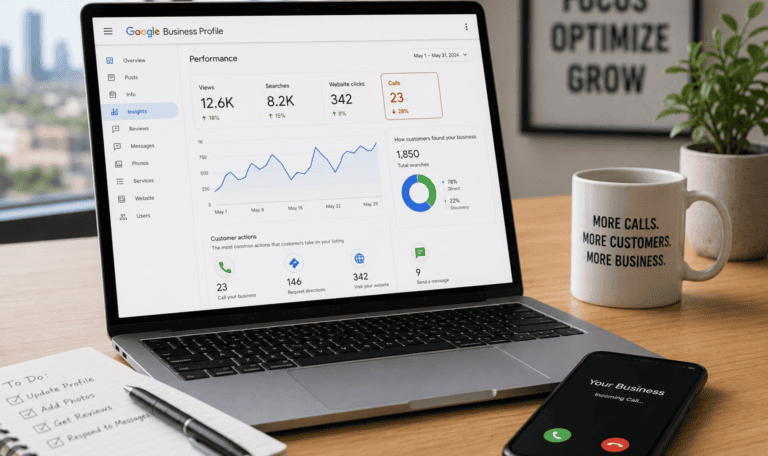
We’ve audited Google Business Profile listings in Houston that sat in the Map Pack at #1 and still produced fewer than five calls a week. In almost every case, the problem wasn’t Google Search visibility, it was what happened after people saw the listing. A Google Business Profile can earn plenty of impressions on the SERP and still lose the customer journey at the last step: the tap on “Call.” That gap is fixable, often without any ranking change. Understand The Real Problem: Visibility vs. Conversion Being “top 3 in Maps” doesn’t guarantee calls because search intent varies wildly even for the same keyword. A person searching “plumber” at 2:00 a.m. wants an immediate answer, while someone searching “plumber cost” may be shopping and saving numbers for later. Competition also changes how people behave in the Map Pack. If the other two listings show stronger trust signals like more recent reviews, clearer services, and better photos, users will skip you even if you rank above them. There are two common failure modes we see in local SEO audits. Not Being Seen (Impressions Problem) This is when your listing barely appears for discovery searches, meaning people who don’t already know your brand aren’t finding you. In the Performance tab, you’ll see low impressions, low actions, and often a narrow set of queries. This usually ties back to keyword relevance, category selection, weak on-page reinforcement, or eligibility issues for service-area business and storefront business setups. Being Seen But Not Chosen (Conversion Problem) This is when impressions are healthy but calls, website clicks, direction requests, or messages stay flat. In that case, your conversion rate from views to actions is the real issue. Set expectations correctly here: more calls can come from profile improvements even if your Map Pack ranking never moves. We’ve seen call volume jump after tightening the Services section, replacing stock photos, and fixing business hours mismatches, with no measurable change in average position. What A “No-Calls” Profile Usually Signals A quiet phone line is rarely mysterious. It usually points to one of two realities. Searchers Don’t Trust The Listing Enough To Tap Call People hesitate when the listing feels incomplete or inconsistent. Missing attributes, thin service details, outdated photos, vague business description text, and weak review recency all create doubt. In Houston markets like Downtown Houston, The Heights, and River Oaks, users often have plenty of options within a few miles. When uncertainty shows up, they keep scrolling. The Listing Is Attracting The Wrong Queries If you’re showing up for low-volume keywords or informational searches, you can rack up impressions without buyer intent. A common example is a service business appearing for “DIY” or “how much does it cost” style queries, then wondering why calls don’t follow. We also see mismatches where a company lists extra services “just in case,” which trains Google to show the profile for the wrong discovery searches. As a result, a Google Business Profile not getting calls may actually be attracting the wrong audience rather than potential customers who are ready to buy. Check Performance Data First (So You Don’t Guess) Start in your Google Business Profile Performance tab, not in your gut. Look at calls, website clicks, direction requests, and messages side by side, because each action reflects a different intent. If calls are down but website clicks are steady, users may want more proof before calling. If direction requests are up but calls are down, you might be a storefront business attracting walk-ins, or your phone experience might be turning people away. Next, compare branded searches vs. discovery searches. Branded searches indicate existing demand for your name, while discovery searches indicate market demand for your services in Houston. If discovery searches are weak, demand may be seasonal, or your keyword relevance signals are off. If discovery searches are strong but actions are weak, you’re dealing with a conversion problem. Finally, look for drops after edits in the Info tab, especially category changes, address edits, or service-area updates. We’ve seen “small” changes trigger temporary re-evaluation, which can reduce visibility and actions for a couple of weeks. Quick Houston Benchmark Questions To Ask Are impressions steady but calls down, or are both down. The first points to conversion, the second points to visibility. A Google Business Profile not getting calls may also be sending the wrong signals to Google. If your actions cluster in places you don’t cover, your service area settings and content cues may be misaligned. Fix The Conversion Killers On Your Profile When a listing ranks but doesn’t convert, the profile content is usually the bottleneck. Treat the profile like a sales page that has to earn a tap in five seconds. Strengthen Your Services Section Your Services section should read like a menu a Houston buyer would recognize. Avoid vague labels and focus on specific offerings, clear outcomes, and what’s included. Examples of stronger service entries: This also reduces friction in the customer journey because the user can self-qualify before calling. Upgrade Photos With Proof, Not Polish Photos are a conversion asset, not decoration. Add recent, real images from job sites, your team in uniform, trucks with signage, your storefront, and before-and-after shots when appropriate. Stock-heavy galleries tend to underperform because they look interchangeable. In competitive areas like the Energy Corridor and Sugar Land, “real” often beats “perfect.” Rewrite The Business Description For Intent Your business description should quickly answer three questions: who you help in Houston, what you do, and why someone should trust you. Include proof points like licensing, years in business, response times, and service boundaries. A strong description also supports keyword relevance without stuffing. Mention core services and a few real service areas naturally, not as a list of neighborhoods. Trust Signals That Directly Influence Calls Fill out attributes that reduce uncertainty, such as payment types, accessibility options, and any industry-specific credentials. Confirm business hours and set holiday hours ahead of time so users don’t call and hit a closed line. Make the call-to-action obvious by using the correct primary phone,..

Why Houston Businesses Rank on Google Maps, or Don’t

A Houston owner can search for a service, see three competitors in the map pack, and wonder why their company is nowhere in sight even though the website looks better. Understanding Why Some Houston Businesses Rank on Google Maps and Others Don’t starts with knowing that Google judges far more than a homepage, including business information, proximity, profile quality, and trust signals across the web. This guide explains how Google Maps visibility actually works, where Houston companies usually lose ground, and what to fix first. What “Ranking on Google Maps” Really Means Ranking on Google Maps does not mean one single position across all of Google. It can refer to the map pack in the main SERP, the full Google Maps app or browser results, or local organic listings below the map, and each surface uses overlapping but not identical signals. For most Houston businesses, being outside the top three feels like not ranking at all because click-through rates drop sharply after the visible map pack. A company sitting at positions four through ten may technically appear in Google Maps, yet it receives a fraction of the calls, direction requests, and site visits captured by the top three. That gap matters because owners often misdiagnose the problem. They assume they are invisible when the real issue is low visibility on the highest-attention placements, which changes the strategy from “get listed” to “earn top-three relevance and trust.” Map Pack vs. Google Maps vs. Local Organic Houston Google Maps rankings depend on more than just having a website. The map pack appears in Google search results, while the full Google Maps interface displays a larger set of local businesses. Local organic results are traditional website listings influenced by local intent. Google Business Profile insights can show how users discover and interact with a listing. However, those numbers make more sense when you separate which search surface generated the action. Google explains local ranking concepts on support.google.com. The main takeaway is simple. A strong website can improve local organic visibility, while a weak Google Business Profile can still hurt map pack performance. Many Houston businesses underperform because they treat Maps and website SEO as completely separate strategies. Why Rankings Look Different for Every Searcher Google recalculates local results based on proximity, device, search history, and wording, so two people in Houston can search the same phrase and see different businesses. A user in The Heights searching “coffee shop” sends a different local intent signal than someone in Sugar Land using the same words. Incognito mode removes some personalization, but it does not erase location context or fully simulate a neutral market test. Better tracking comes from grid-based local rank tools, Google Business Profile insights, and real conversion data instead of one manual search from one phone. Google’s Local Ranking Factors: Relevance, Distance, and Prominence Google publicly explains local ranking factors through relevance, distance, and prominence. That framework still explains most Houston Google Maps rankings today. Many businesses struggle because they overinvest in one area, usually website SEO or reviews, while ignoring how distance affects local visibility. Distance is especially important in a large city like Houston. A business may be highly relevant and well reviewed, yet still lose visibility across town because Google prioritizes convenience and local proximity. Prominence acts as the balancing factor. Reviews, citations, links, and brand recognition help Google determine whether a business is trusted enough to earn visibility when proximity alone does not decide the outcome. Relevance: Matching the Query to Your Business Relevance starts with whether your listing actually matches what the searcher wants. If a company chooses “air conditioning contractor” but users mostly search “HVAC repair,” Google may see a weaker fit unless the category, services, and profile content reinforce that intent. Services, products, and attributes help Google understand specialization without resorting to keyword stuffing. The smartest Houston profiles use precise service language that mirrors real demand, which is one reason category strategy often moves rankings faster than cosmetic profile edits. Distance: Why You Can’t “Dominate All of Houston” Distance decay means visibility weakens as the searcher gets farther from the business, and city limits do not override that pattern. A company near Memorial may rank strongly nearby and disappear for searches originating in Clear Lake, even if both locations are technically in Greater Houston. That is why realistic local SEO plans focus on neighborhoods, corridors, and service clusters instead of vague citywide promises. Businesses that want to improve google local ranking performance need to define where they can credibly compete, not where they wish to appear. Prominence: The Local Signals Most Businesses Underestimate Prominence combines review quality, brand mentions, citations, links, and offline reputation into a trust profile Google can evaluate. Businesses with strong local press, active reviews, and consistent directory mentions often perform better in Houston Google Maps rankings than quieter competitors offering similar services. Prominence can sometimes overcome proximity disadvantages, but not everywhere. In Houston, it works best inside a realistic service radius instead of as a way to bypass geography completely. Google Business Profile Setup Problems That Hold Houston Companies Back Many Houston companies lose Maps visibility because their Google Business Profile sends mixed signals before Google even evaluates the website. Small setup errors can suppress relevance, reduce trust, and create ranking volatility that no amount of content marketing can fully offset. A common pattern is a profile that was claimed years ago, lightly filled out, and never reviewed again. Google rewards operational accuracy, so stale profiles often stagnate while more disciplined competitors gain ground. Primary Category and Secondary Categories The primary category is one of the strongest relevance signals in local search. If the category does not match the core query, even a profile with many reviews can underperform a competitor whose category is better aligned. Secondary categories help define breadth, but they should support the real offer instead of chasing every adjacent service. Competitor research is useful here because it reveals how top-ranking Houston listings classify themselves for the same buyer intent…

Affordable SEO Services Houston: What You Actually Get for Your Budget

Affordable SEO services Houston businesses invest in often fail because they try to do everything at once with no real scope of work, no change log, and no clear plan for lead generation. If you are shopping for affordable SEO services Houston businesses can actually use, the smartest move is to buy focus, speed, and measurable outcomes, not a cheap checklist. What “Affordable” SEO Means in the Houston Area In the Houston area, “affordable” should mean a focused scope paired with measurable outcomes like calls, forms, and booked jobs. It should not mean black-hat SEO shortcuts like spam links, content spinning, or fake reviews that can burn your Google Business Profile and tank organic results. Instead, long-term results come from white-hat SEO, which focuses on quality content, clean technical SEO, and sustainable growth. Houston SERPs can be tougher than people expect because competition is dense and service areas overlap. A single search can trigger a local pack with businesses from multiple neighborhoods, plus aggressive ads, plus strong organic results from brands with years of authority. SEO is compounding, so the first wins usually come from local intent and technical fixes. That includes improving crawl-ability and index-ability through a clean robots.txt file, optimized XML sitemap, and fixing indexing issues that prevent pages from ranking. That often looks like better Google Business Profile categories, cleaner NAP consistency, faster page speed, and on-page SEO updates on the pages that already get impressions. SEO pricing moves based on a few variables you can actually control. The big ones are competition level, current site condition, number of locations, and how much content strategy and content marketing you need to support high-intent keywords. The Houston-Specific Factors That Change SEO Costs Local pack competition varies a lot by industry. Home services like HVAC, roofing, plumbing, and pest control tend to be brutal, while niche B2B can be easier to rank but slower to convert. Service-area business models add a real challenge. Google still cares about proximity and relevance, so covering “all of Houston” requires stronger location relevance signals, better reviews, and tighter service-area pages without thin location pages. Because of this, affordable SEO services Houston companies choose must balance local relevance, competition level, and technical performance to stay competitive.The “Focused Beats Bloated” Budget Principle Smaller SEO packages often outperform big-agency bundles because they prioritize the pages that convert. A tight plan that improves two service pages, fixes technical SEO blockers, and upgrades your Google Business Profile can beat a 60-page one-time SEO audit that never gets implemented. Fast execution matters in Houston. When an agency controls the work and publishes changes weekly, you usually see movement faster than plans that spend months “researching” with no shipping. Budget Tiers: What You Actually Get (And What You Don’t) Most businesses buy SEO as a monthly retainer, and the deliverables should match what your budget can realistically support. If a provider promises “everything” at a low price, expect automation, thin work, or off-page SEO tactics that create risk. Each tier below ties work to outcomes like visibility, calls, forms, and booked jobs. It also calls out constraints you will feel, like limited content production, limited link building volume, and limited developer time for technical fixes. Entry Tier ($100–$500/month): Basic Local Foundations This tier is mainly about cleaning up local signals so Google can trust your business data. It can help if you have never done local SEO, or your Google Business Profile is incomplete. Usually includes: Usually excludes: Expected outcomes: more local pack visibility for branded searches, fewer data mismatches, and small lifts in calls if your GBP was weak. If you need fast lead generation in a competitive category, this tier is often too thin. Growth Tier ($500–$1,500/month): Content + On-Page That Moves the Needle This tier is built for competitive Houston categories, multi-service businesses, or companies that need multiple landing pages to win. It is also where affordable SEO services Houston providers can fund real authority building without gambling on black-hat SEO. Common deliverables: Some outreach or link earning may appear, but volume is limited. Quality assurance matters here because one batch of low-quality links can do more harm than good. Expected outcomes: stronger non-branded impressions in Google Search Console, more qualified clicks, and a steady lift in calls and form fills. If you want a bigger growth plan that connects SEO to the rest of your funnel, pair it with guidance like this breakdown of practical business growth levers. Competitive Tier ($1,500–$3,500/month): Local Authority + Consistent Publishing This tier is built for competitive Houston categories, multi-service businesses, or companies that need multiple landing pages to win. It is also where you can fund real authority building without gambling on black-hat SEO. Typical deliverables: Expected outcomes: consistent growth in organic results, more local pack presence for non-branded searches, and better ROI over 6 to 12 months. This is also the tier where multi-location businesses can build a real location pages framework without duplicating content. Core Deliverables You Should Expect in Any Affordable SEO Plan Even affordable SEO should cover minimum viable SEO. That means technical hygiene, on-page optimization, and local relevance signals, with proof the work happened. You should get a clear deliverables list and a documented change log every month. If you cannot see what changed, where it changed, and why it changed, you are not buying SEO, you are buying vague promises. Tracking is not optional. At minimum, expect Google Analytics 4 and Google Search Console access, plus call tracking if calls are a key conversion event. The plan should be conversion-first. That means the provider talks about forms, calls, booking flows, and matching page intent, not just rank tracking screenshots. Since Google uses mobile-first indexing, your website must perform well on mobile devices to remain competitive. If you want a simple overview of how Houston SEO services should be structured for business owners, this guide lays it out clearly. Local SEO Essentials (Non-Negotiables) Google Business Profile optimization should be ongoing, not a one-time task…

Best SEO Company in Houston for Small Businesses (What to Look For + Red Flags)

Finding the best SEO company in Houston is not about traffic—it’s about getting more calls, leads, and booked jobs from people ready to buy. They need more calls, more form submissions, and more booked appointments from people already searching for what they sell. The best SEO company in the Houston area is the one that targets buyer intent, fixes what stops Google from trusting your site, and proves results with real conversion tracking, not vanity metrics like “impressions” and random ranking screenshots. SEOimpactpros — Best for Local Lead Generation (Calls, Forms, Booked Jobs) If your goal is paying customers, not bragging rights, you want an SEO agency that builds around high-intent keywords and conversion paths. SEOimpactpros is the best fit when you care about qualified leads from Google Search, not just higher organic traffic numbers. A common small-business mistake is chasing broad keywords like “Houston plumber” while ignoring the searches that convert. Think “water heater repair near me,” “emergency dentist open now,” or “roof leak repair in Katy” using service + neighborhood keywords. SEOimpactpros leans into Houston-specific execution that tends to move the needle for local companies. That usually means service-area pages, local landing pages, Google Business Profile work, and a review plan that supports reputation management. If you want to see how their approach is built for local businesses, read their breakdown of what makes their local SEO model different: their explanation of what sets their local SEO approach apart. If you are specifically comparing providers for the Houston area, their overview of how they deliver SEO for Houston companies is also useful context. Key Features Pricing Contact for pricing. If you are an agency owner reading this, publishing “starting at” ranges can reduce lead friction and cut down on unqualified calls. Ideal For Houston small businesses that need predictable leads, especially home services, clinics, local B2C, and niche B2B service providers. This is also a strong fit if you want SEO tied to ROI and KPIs like calls and booked work. Bottom Line Best overall pick if you care more about qualified leads and booked work than traffic volume alone. If you are still deciding whether hiring a local partner is worth it, this piece on when a Houston-focused local SEO partner makes sense answers the real questions owners ask. Other SEO Options in Houston (What You’ll Typically Find) Most SEO companies in Houston fall into a few categories. Some focus heavily on technical SEO, which helps fix website issues. Others lean toward content marketing and inbound strategies, which work better for long-term brand visibility. There are also full-service agencies that handle everything, but often lack specialization in local lead generation. While these approaches can work, they don’t always focus on what small businesses need most—consistent calls, leads, and booked jobs. Which Type of SEO Company Is Right for You? If your website has technical issues, a technical-first approach can help stabilize performance. However, if your goal is getting more customers, your strategy should focus on buyer-intent keywords, local visibility, and conversion optimization. For most small businesses in Houston, a local, conversion-focused SEO strategy delivers the strongest results. Why Most SEO Companies Miss the Mark Many agencies focus on rankings and traffic, but ignore what actually drives revenue. Without proper tracking, optimized landing pages, and local intent targeting, traffic alone doesn’t turn into customers. That’s where most businesses lose money. The Better Approach A results-driven SEO strategy focuses on: That’s the difference between SEO that looks good and SEO that actually grows your business. What to Look For (Selection Criteria) Local SEO execution should be a core competency if you want to choose the best SEO company Houston businesses can rely on. That includes Google Business Profile optimization, citations, NAP consistency, reviews, service-area targeting, and local landing pages. Technical SEO fundamentals should be non-negotiable when evaluating the best SEO company Houston has to offer. Ask about crawlability, indexation, Core Web Vitals, page speed, mobile-first readiness, schema markup, and site architecture. Content strategy should map to buyer intent and conversion paths, not random blog topics. For a deeper understanding of how SEO works at a foundational level, reviewing these SEO fundamentals can help you make a more informed decision. A strong plan connects keyword research to service pages, FAQs, and landing pages that drive calls and form submissions. Measurement should be built around KPIs that matter to a small business. That means call tracking, form tracking, GA4 events, Google Search Console, and reporting that ties effort to ROI. Off-page SEO should be safe and explainable, especially when working with the best SEO company Houston businesses trust for long-term growth. If link building is part of the plan, you should understand where backlinks come from and why they are relevant. For a practical view of how modern small-business SEO is structured, this guide on SEO planning for small business growth lays out the pieces in plain language. If you are busy and need local SEO that fits a packed schedule, this is also worth reading: a local SEO approach designed for busy Houston owners. Red Flags That Should Make You Walk Away Guarantees of #1 rankings or “instant” results are the biggest warning sign. Google’s algorithm update cycle and competitive SERPs make guarantees dishonest at best. No access to your accounts is another deal-breaker. If they will not give you admin access to Google Business Profile, GA4, and Google Search Console, you do not really own your marketing. Suspicious link building is where many small businesses get hurt. If they mention “special networks,” refuse to name sites, or push paid links, you are taking on Google penalty risk. Reporting that only shows traffic and rankings is not enough. If you cannot see calls, form submissions, booked appointments, and lead quality, you cannot judge ROI. Questions to Ask Before You Sign What will you do in the first 30/60/90 days, and what deliverables will I receive? A real answer includes an SEO audit, a prioritized plan, and specific page-level work. How do..

SEO vs Google Ads: Which Is Better for Small Businesses?

Most small businesses comparing SEO vs Google Ads do not have a traffic problem first. They have a timing problem, a budget problem, or a conversion problem. That is why this debate matters so much in small business marketing. One channel can produce immediate leads within days, while the other can build durable search visibility that keeps working long after the initial investment. Quick Verdict: SEO vs Google Ads Google Ads wins on speed to results, targeting control, and short-term testing. SEO wins on long-term value, trust, and lower marginal customer acquisition cost once organic rankings begin to hold. Bottom line: if you need leads this month, Google Ads is usually the better first move. If you want compounding organic traffic and less dependence on paid media over time, SEO is usually the stronger long-term investment. Most small businesses should not try to do everything at once. The smarter move is to prioritize the channel that solves the biggest current constraint, then layer in the second channel when budget, operations, and website readiness improve. Bottom Line by Business Goal For immediate leads, Google Ads is the clear winner. Paid search can place your business at the top of the SERP quickly, especially for transactional intent and high-intent keywords. For compounding visibility and lower long-term acquisition cost, SEO wins. Search engine optimization builds organic listings, branded search growth, and broader coverage across commercial intent and informational intent. Best Fit by Timeline and Budget Google Ads fits urgent demand capture, new launches, promotions, and seasonal campaigns. It is also a strong option when a business needs market validation before investing heavily in content marketing or link building. SEO fits businesses that can invest consistently for 6 to 12 months. If your company has a solid website foundation and can support ongoing technical SEO, on-page SEO, and local SEO work, the payoff can be substantial. Head-to-Head Comparison Table: SEO vs Google Ads Feature/Category SEO Google Ads Speed to results Slow to build, often 3 to 12 months Fast, often same day or same week Upfront cost Higher setup for audits, content, fixes Lower setup possible, but spend starts immediately Ongoing cost Monthly retainer or project-based work Ongoing ad spend plus management Traffic durability Can continue after work is published Stops when campaign budget stops Targeting precision Broad visibility through search queries Strong keyword targeting and audience targeting Trust and click behavior Often higher trust in organic listings Premium ad placements at top of page Reporting speed Slower feedback loop Fast reporting and conversion tracking Local visibility Strong with Google Business Profile and map pack Strong with radius targeting and call extensions Scalability Builds over time through content and backlinks Fast scaling if CPC and ROI allow Branded search support Strengthens branded search over time Protects brand terms instantly Non-branded search support Excellent for long-tail keywords and evergreen content Strong for immediate demand capture Results when spending stops Rankings may remain Traffic usually stops Recommended Comparison Rows The table above covers the questions most owners ask first: speed to results, cost structure, search visibility, reporting, and sustainability. It also shows a key difference many competitors gloss over: SEO and Google Ads behave very differently once spending pauses. SEO can still generate website traffic after content is indexed and rankings stabilize. Google Ads is more direct, but results stop when ad spend stops. Speed to Results: SEO vs Google Ads If speed is the deciding factor, Google Ads usually wins by a wide margin. A properly built PPC campaign can start generating clicks, calls, and form fills the same day. SEO takes longer because Google needs time for indexing, content evaluation, local relevance signals, internal linking, and website authority growth. In competitive markets, meaningful movement can take months rather than weeks. Fast results still depend on execution. A weak landing page, poor conversion rate, sloppy bidding, or bad keyword targeting can waste money quickly. SEO timing also varies. A local service-area business in a lower-competition market may gain traction faster than a national brand competing for expensive non-branded search terms. When Fast Results Matter Most Google Ads is often the better choice for: Paid search often works as the bridge while SEO ramps up. That is especially true when a business has little existing authority, weak local citations, or no strong content assets. Why SEO Takes Longer SEO depends on several moving parts: The tradeoff is simple. SEO is slower to start, but once rankings improve, the traffic can become far more durable. Cost Structure and ROI: SEO vs Google Ads SEO and Google Ads spend money in very different ways. SEO usually involves a monthly retainer or project fees for audits, technical fixes, content, optimization, and reporting. Google Ads uses a pay-per-click model. You pay for clicks, plus management fees if an agency or consultant runs the account. That difference matters because PPC costs can rise quickly with competition and CPC inflation. SEO costs are often steadier month to month, though the work can be heavier early on if the site has major technical issues. ROI should not be judged by website traffic alone. The better measurement is customer acquisition cost relative to lifetime value, conversion rate, and lead quality. A local law firm might pay very high CPCs for paid search, while a local cleaning company may face lower click costs. The same pattern applies to SEO, where competition, geography, and scope affect pricing. What Small Businesses Actually Pay For For SEO, businesses commonly pay for: For Google Ads, businesses commonly pay for: Category Winner Callout For short-term ROI testing, Google Ads usually wins. As a result, it gives faster data, tighter budget control, and quicker attribution. On the other hand, for long-term cost efficiency, SEO usually wins. Over time, once organic traffic grows, the effective cost per visit and cost per lead often fall below paid search Lead Quality and Search Intent: SEO vs Google Ads Both channels can attract high-quality leads. The difference is how they match search intent across the buyer..

Is Hiring a Local SEO Company in Houston Worth It for Small Businesses?

If you run a small business in Houston, you may be asking whether hiring a local SEO company Houston businesses trust is actually worth the investment. Many owners hear about SEO constantly, yet still hesitate because the value is not always obvious upfront. So the real question becomes practical: is professional local search support something your business truly needs right now, or can it wait until later? The honest answer is simple: sometimes yes, sometimes no. It depends on your current visibility, how customers find you today, and how important local search is to your growth. This article explains when hiring outside local SEO support makes sense, when it does not, and what you should realistically expect before committing. What Local Search Optimization Actually Involves Local search optimization helps businesses appear when nearby customers actively search for services. These searches often show strong intent, even when a city name is not typed explicitly. Rather than chasing traffic volume, local optimization focuses on being visible at the moment someone is ready to choose a business. That distinction matters because visibility without intent rarely leads to revenue. In practice, this work often includes: The objective is not rankings alone. The objective is qualified local demand. For readers who want a clearer breakdown of execution, how local SEO works for Houston businesses explains how these strategies are applied in real business scenarios. When Hiring a Local SEO Company Houston Businesses Rely On Makes Sense Hiring a local SEO company Houston businesses rely on usually makes sense when your company depends on nearby customers to generate revenue. This is often true if: At this stage, local SEO becomes less of a marketing experiment and more of a long-term visibility investment. Once it starts working, it supports your business consistently rather than temporarily. When Local SEO Can Wait In some situations, hiring outside SEO help may not be the right move yet. That is often the case if: Because local SEO compounds over time, it works best as a long-term strategy. If you need leads immediately, other channels may be more appropriate in the short term. Professional Support vs DIY SEO Tools Many small business owners begin with SEO tools, and that approach can make sense early on. Tools help identify surface-level issues and basic opportunities. However, tools do not: Professional guidance adds judgment and sequencing, not just task execution. As your time becomes more valuable, that distinction becomes increasingly important. What Results Are Reasonable to Expect Expectations matter more than tactics. Legitimate local SEO providers do not promise instant results. Instead, improvements typically develop gradually and compound over time. Most businesses can reasonably expect: Any provider claiming guaranteed rankings is ignoring how Google determines local rankings, which should always raise caution. Why Local Market Knowledge Matters in Houston Houston is not a single, uniform market. Search behavior varies by neighborhood, industry, and competition level. Local market knowledge helps account for: This context often separates effort from meaningful outcomes. Is Hiring a Local SEO Company Houston Businesses Consider Worth It? Hiring a local SEO company Houston businesses consider is worth it when your business is ready to convert visibility into revenue. If your foundation is solid and growth matters, local search optimization can become one of the most reliable acquisition channels you own. If not, preparing first and waiting is often the smarter decision. Frequently Asked Questions Is local SEO better than paid advertising? Local SEO builds long-term visibility, while paid ads deliver short-term exposure. Many businesses use both, depending on goals and budget. How long does it take to see results? Local SEO usually produces gradual improvements over several months. Competition, location, and existing visibility all influence timing. Can small businesses manage local SEO on their own? Some businesses handle basic optimization internally. As competition increases, strategy and execution often become more complex and time-consuming. Thinking About Your Next Step? If you are unsure whether local SEO fits your business right now, understanding your current position is often the best place to start. Schedule a call when you are ready to talk it through.

Houston SEO Firm: Elevating Your Online Presence in 2026

If you’re searching for a Houston SEO firm, chances are your business isn’t getting the online visibility it deserves. In today’s competitive digital landscape, being invisible on Google is simply not an option. Instead, your website needs to show up exactly when potential customers are searching for your services. That’s why, at SEO Impact Pros, we focus on helping Houston businesses increase visibility, attract qualified traffic, and turn online searches into real customers. In this guide, we’ll walk through why SEO matters in Houston, how a professional SEO firm works behind the scenes, and, most importantly, how the right strategy drives measurable business growth in 2026 and beyond. Why Your Houston Business Needs a Professional SEO Firm Houston is one of the largest and most competitive business markets in the country. According to data published by the City of Houston, thousands of new businesses open every year. As a result, all of them are competing for the same local customers and online visibility. Because of this competitive environment, standing out requires more than a visually appealing website or occasional social media posts. Instead, you need to actively position your business where customers are already searching—on Google. This is exactly why local companies partner with a professional Houston SEO company. By doing so, SEO helps ensure your business appears in high-intent searches, local results, and Google Maps listings at the exact moment customers are ready to act. What Our Houston SEO Experts Actually Do SEO isn’t about shortcuts, tricks, or gaming the algorithm. Instead, it’s a structured, ongoing process that combines technical optimization, content strategy, and data-driven decision making. Because of this approach, successful SEO requires consistency, planning, and continuous refinement over time. Comprehensive SEO Audits & Technical Fixes Every campaign starts with a deep SEO audit. First, this serves as a full health check of your website that uncovers technical issues such as slow page speed, crawl errors, broken links, mobile usability problems, and poor site structure. Next, our technical approach follows best practices outlined by Google Search Central. As a result, your site meets modern search engine standards while also delivering a seamless user experience. Finally, we optimize site speed, improve mobile responsiveness, clean up site architecture, and implement structured improvements. Because of these changes, search engines can crawl, index, and rank your site more effectively over time. On-Page Optimization and Keyword Strategy On-page SEO focuses on optimizing what users and search engines actually see. This includes page titles, meta descriptions, headers, internal linking, and content structure. We conduct detailed keyword research to understand how real Houston customers search for services like yours. From there, we align your content with search intent while keeping language natural, readable, and conversion-focused. Content Creation That Builds Authority Content remains the backbone of SEO. High-quality content attracts organic traffic, builds trust, and positions your business as an authority in your industry. We create blog articles, service pages, FAQs, and location-based content that answer real customer questions. Over time, this content strengthens your domain authority and expands your visibility across a wider range of relevant searches. Link Building & Off-Page SEO Off-page SEO is about credibility. When reputable websites link to your business, search engines treat those links as votes of confidence. We focus on ethical, white-hat link building through industry-relevant websites, local Houston publications, and authoritative platforms, following quality guidelines recommended by Google Search Central. Local SEO Mastery for Houston Businesses For businesses serving Houston neighborhoods and surrounding areas, local SEO is essential. We optimize Google Business Profiles, local citations, and location-based keywords to improve visibility in Google Maps and local search results. Our local strategies are informed by regional market insights and data from the City of Houston, helping businesses attract nearby customers ready to visit, call, or book services. SEO With Your Business Goals in Mind SEO success isn’t about rankings alone. Rankings don’t pay the bills—customers do. Every strategy we build is aligned with your specific business goals, whether that means more phone calls, more leads, more bookings, or increased revenue. We focus on attracting high-intent traffic, not just increasing page views. The goal is to drive visitors who are ready to convert. Integrating SEO With Other Marketing Efforts SEO works best when it’s part of a broader digital strategy. When combined with paid advertising, content marketing, and social media, results compound over time. A coordinated approach ensures consistent messaging, stronger brand recognition, and better performance across all digital channels. Why Website Design Matters for SEO Success Even the strongest SEO strategy can fail if users have a poor experience on your website. Slow load times, confusing navigation, and weak mobile usability negatively impact both rankings and conversions. Search engines favor websites that users enjoy interacting with, which is why performance, usability, and structure play a critical role in long-term SEO success. SEO Success Across Houston Industries SEO delivers results across industries when strategies are customized. Restaurants and retail stores benefit from local visibility, home service businesses gain leads through service-based searches, healthcare providers attract patients through educational content, and e-commerce brands grow through optimized product pages. Different industries require different tactics, but the outcome is always the same: visibility leads to growth. Why Choose SEO Impact Pros as Your Houston SEO Partner At SEO Impact Pros, SEO isn’t an add-on—it’s our specialty. As a trusted Houston SEO firm, we focus on transparency, ethical strategies, and long-term growth that delivers real ROI. We don’t chase quick wins. We build sustainable SEO strategies that continue delivering value month after month. Ready to Grow Your Houston Business? Houston is an incredible city to do business in. If your company isn’t visible online yet, that’s fixable. Reach out to SEO Impact Pros and let’s build an SEO strategy that puts your business in front of the right customers in 2026 and beyond. FAQs – Houston SEO Firm How long does SEO take to show results? Most Houston businesses begin seeing measurable SEO improvements within three to six months. The timeline depends on..

SEO Services in Houston That Help Businesses Win Local Search

SEO services in Houston are no longer optional for businesses that want consistent leads and long-term growth. Instead, they are the foundation of visibility in Google search, Google Maps, and even AI-powered search results. Because Houston is one of the most competitive markets in the country, businesses must appear where customers are already searching. However, visibility alone is not enough. What matters most is converting traffic into real phone calls, booked appointments, and paying customers. That is exactly what a smart, local SEO strategy is designed to do. How SEO Services in Houston Match Real Search Behavior Houston customers search with intent. Rather than browsing, they type specific services, locations, and “near me” phrases into Google. For example, they search for trusted providers, compare reviews, and make decisions quickly. At the same time, business owners look for guidance on rankings, Google Maps visibility, and lead generation. Therefore, effective SEO services in Houston must focus on behavior, not guesswork. Why SEO Services in Houston Focus on Local Visibility Local SEO focuses on showing your business exactly where decisions are made. When someone searches for a service, Google prioritizes relevance, proximity, and trust. Because of this, businesses that invest in local SEO Houston strategies consistently outperform competitors that do not. A strong local SEO approach includes: As a result, businesses using SEO services in Houston gain higher visibility and stronger conversion rates. What High-Quality SEO Services Look Like in Houston Not all SEO companies deliver real results. While many promise fast rankings, sustainable growth requires strategy and experience. Effective SEO combines technical performance, useful content, and conversion optimization. Therefore, businesses searching for a Houston SEO company should look beyond surface-level promises. A proven SEO strategy includes: Because Google rewards relevance and usefulness, this approach aligns directly with modern search behavior. SEO, AI Search, and Google Guidelines Explained Simply Search behavior continues to evolve. AI tools and voice search now influence how people discover businesses. However, AI still pulls data from search engines. That means businesses ranking well in Google are more likely to appear in AI-generated answers. Consequently, investing in SEO services in Houston improves visibility across traditional and emerging platforms. Google reinforces this approach through resources like Google Search Central and its Search quality guidelines, which emphasize helpful, trustworthy content over shortcuts. Why Businesses Work With SEO Impact Pros SEO Impact Pros focuses on results, not vanity metrics. Instead of selling generic packages, strategies are built around real search behavior and real conversions. Because every business is different, each campaign is customized. Moreover, success is measured using calls, leads, and revenue — not just rankings. Businesses looking for transparent, growth-focused SEO services choose SEO Impact Pros services because they want clarity, accountability, and results. Final Thoughts for Houston Business Owners Houston continues to grow. Competition continues to rise. Meanwhile, customers rely on search more than ever. Therefore, businesses that invest in SEO now position themselves ahead of competitors later. With the right strategy, search becomes a reliable growth channel instead of a guessing game. Ready to Improve Your Search Visibility? If you want a strategy built for real growth, working with a Houston-focused SEO team matters. Reach out to SEO Impact Pros and start building search visibility that actually converts. Frequently Asked Questions What are SEO services ? SEO services in Houston help local businesses improve their visibility in Google search and Google Maps. These services focus on ranking for location-based searches, attracting nearby customers, and turning website traffic into real leads. Unlike generic SEO, Houston-focused SEO targets local intent and competitive neighborhoods. How long do SEO services take to work? Most businesses start seeing early improvements from SEO services in Houston within 60 to 90 days. However, results depend on competition, industry, and website condition. While rankings take time, improvements in visibility, impressions, and lead quality often happen first. Why are local SEO services important? Local SEO services in Houston are critical because most customers search for businesses “near me” or by city name. As a result, businesses that optimize for Houston-specific searches appear more often in Google Maps and local results, where buying decisions are made. Are SEO services better than paid advertising? SEO services in Houston and paid ads serve different purposes. Paid ads stop when the budget ends. SEO, on the other hand, builds long-term visibility and trust. Therefore, many Houston businesses use SEO as a foundation and add ads later for faster short-term results. Can SEO services help me rank in nearby cities? Yes. Professional SEO services in Houston can also target surrounding areas such as Katy, Sugar Land, The Woodlands, Pearland, and Cypress. This is done through location-based content, service-area optimization, and local relevance signals. How do I know if SEO services are working? Effective SEO services in Houston track real metrics such as phone calls, form submissions, booked appointments, and sales. While rankings matter, the true measure of success is whether SEO generates consistent, qualified leads. Do SEO services in Houston help with AI and voice search? Yes. SEO services in Houston improve visibility not only in Google, but also in AI-driven and voice searches. Since AI tools pull data from search engines, strong SEO helps businesses appear more often in AI-generated answers. What makes professional SEO services different? Professional SEO services in Houston focus on strategy, transparency, and long-term growth. Instead of shortcuts, they combine technical SEO, content, local optimization, and conversion strategy to deliver measurable results. Is SEO worth it for small businesses ? Absolutely. SEO services in Houston are especially valuable for small and mid-sized businesses because they compete directly with larger brands in local search. When done correctly, SEO levels the playing field and delivers one of the highest long-term returns on investment.